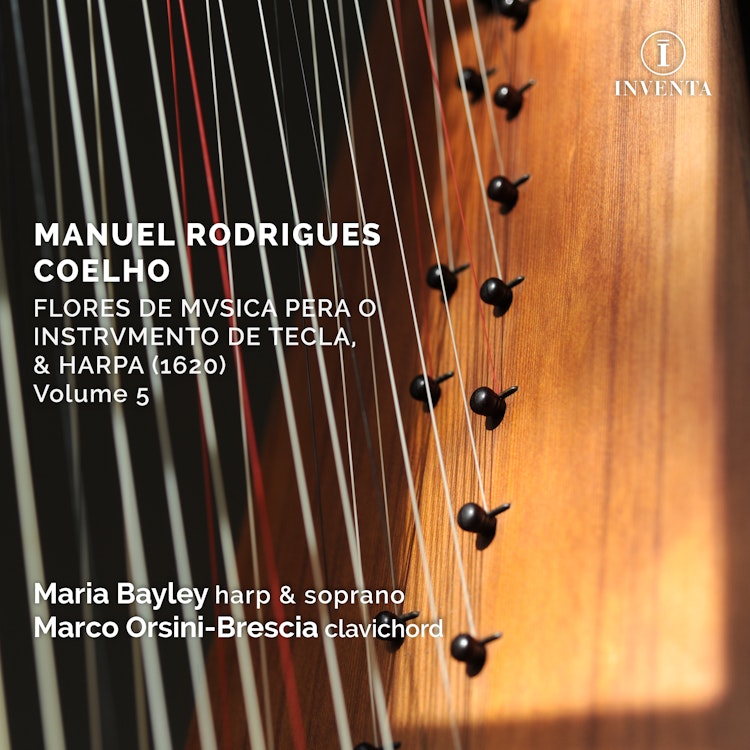
Coelho: Flores de Musica pera o Instrumento de Tecla, & Harpa, Vol. 5
6/20/2025, 9 Tracks, 1:10:33
Featuring
Marco Orsini-Brescia
Maria Bayley
Manuel Rodrigues Coelho
Orlando di Lasso
Anonymous
Did you know?
1/7
Composition History
Coelho's "Flores de musica pera o instrumento de tecla & harpa" (1620) is his only known work and one of the largest music works printed in the 17th century, spanning over five hundred pages.
Composer Biography
Manuel Rodrigues Coelho, born around 1555 in Elvas, Portugal, served as an organist in his hometown, Badajoz (Spain), and later as organist of the Royal Chapel in Lisbon.
Interpretation
Coelho's music, originally idiomatic for keyboard, presents technical challenges for the harp due to its rapid string decay and the traditional Iberian harp fingering using only three fingers per hand.
Recording & Production
This album is the first complete recording of Coelho's "Flores de Musica" and was prepared using a new three-volume edition curated by João Vaz.
Instruments
The Iberian harp, also known as 'arpa de dos órdenes', was a central instrument in Portugal and Spain from the late Renaissance through the Baroque period, used in courtly, ecclesiastical, and theatrical settings.
Recording & Production
The clavichord pieces were recorded in the lower choir of the Igreja de São Vicente de Fora in Lisbon, a location coetaneous to Coelho's life and music, providing an inspiring atmosphere.
Instruments
The 'arpa de dos órdenes' refers to cross-strung harps with two interlaced rows of strings, allowing for more fluid chromaticism compared to Italian harps with parallel rows.