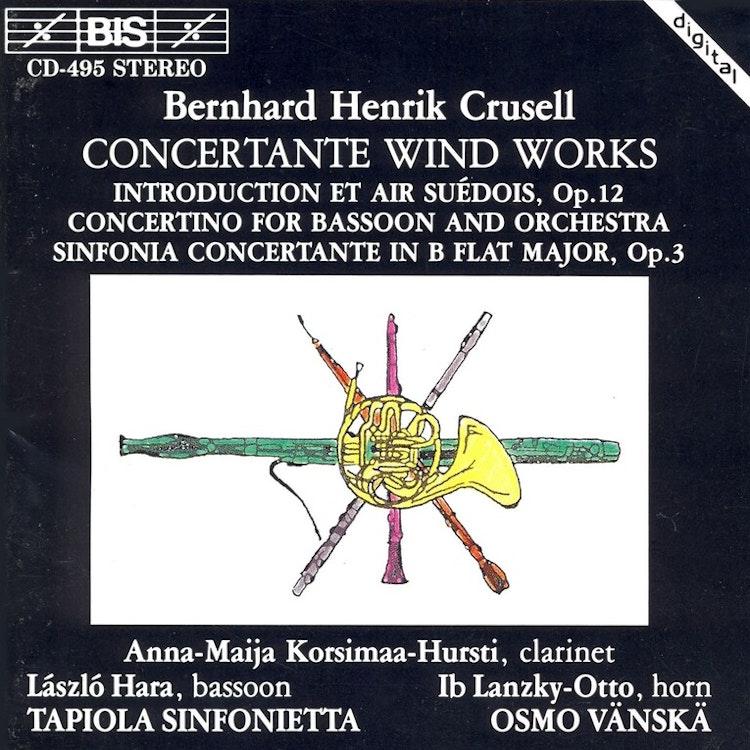
Crusell: Concertante / Bassoon Concertino / Introduction and Swedish Air
11/30/1991, 7 Tracks, 59:35
Featuring
Osmo Vänskä
Anna-Maija Korsimaa-Hursti
László Hara
Ib Lanzky-Otto
Tapiola Sinfonietta
Bernhard Henrik Crusell
Did you know?
1/7
Performer Biography
Osmo Vänskä, the conductor on this album, is also an accomplished clarinetist and continues to perform on the instrument despite his busy conducting schedule.
Composition History
The Concertino for bassoon was composed by Crusell for his son-in-law, Frans Preumayr, a renowned bassoonist, just before Preumayr embarked on a major European concert tour.
Composer's Artistic Vision
Crusell primarily composed for wind soloists, not symphonies, because he and his colleagues in the Stockholm opera orchestra needed new repertoire for both concerts and salons.
Compositional Technique
The Concertino for bassoon incorporates a melody by Boieldieu, first as a minor-key variation and then in its original major form, serving as the basis for two bassoon variations.
Composer Biography
Bernhard Henrik Crusell, born in Finland in 1775, served as the principal clarinetist of the Swedish Royal Opera orchestra from 1793 to 1833.
Notable Performances
Crusell's Sinfonia Concertante, Op.3, was his most frequently performed work in 19th-century Stockholm, often featuring a trio of wind soloists including Crusell himself.
Composition History
Crusell's "Introduction et Air suédois, Op.12" was based on a popular Swedish drinking song from 1795 and marked his debut as a composer in Stockholm in 1804.
You might also enjoy...
Double Bass Recital: Sinclair, David - Hoffmeister, F.A. / Pichl, W. / Vanhal, J.B. (Forgotten Treasures, Vol. 3)