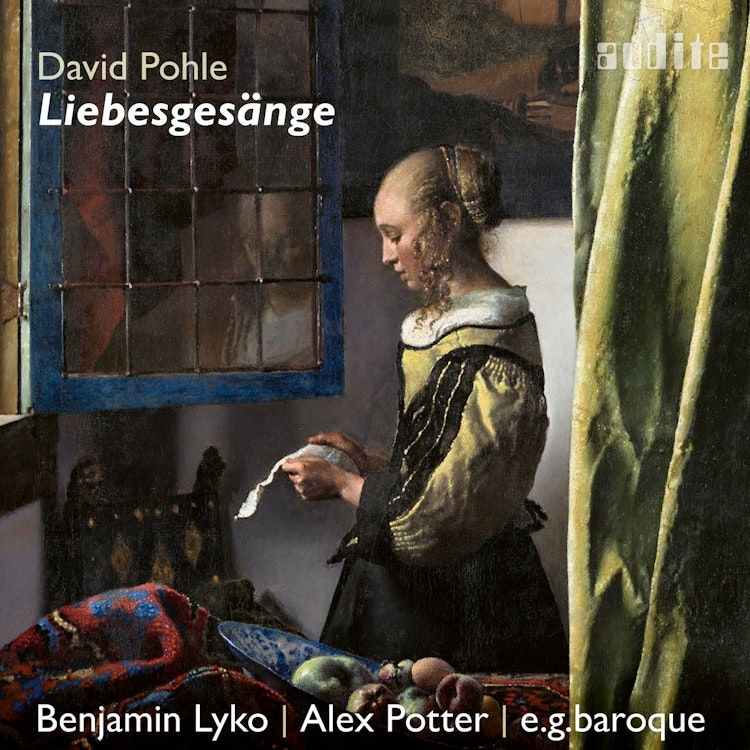
e.g.baroque, the ensemble on this recording, was founded in 2021 and consists of musicians from renowned baroque orchestras such as the Akademie für Alte Musik Berlin and the Freiburger Barockorchester.
Historical Context
Paul Fleming, the librettist for the Liebesgesänge, lived and worked during the Thirty Years' War, a period marked by destruction, displacement, plague, and death in Central Europe.
Composer's Artistic Vision
David Pohle's strong focus on interpreting the sung word in his Liebesgesänge identifies him as an admirer and imitator of Heinrich Schütz, who also followed texts with detailed precision.
Compositional Technique
Pohle's Liebesgesänge are all conceived as duets for two equal vocal parts with two obbligato violin parts, likely to emphasize the torn nature of the persona and represent the two sisters in the poems.
Composer Biography
David Pohle, the composer, was a recognized member of the musical establishment at the Dresden court, and Heinrich Schütz, the court Kapellmeister, became godfather to one of Pohle's children in 1665.
Recording & Production
This album features premiere recordings of David Pohle's Zwölf Liebesgesänge.
Composition History
David Pohle, a Kassel court musician, dedicated his first work, the Liebesgesänge (Love Songs), to Landgrave Wilhelm VI of Hesse-Kassel in 1650.
You might also enjoy...
Splendeurs de Versailles (Collection Château de Versailles)
Georg Friedrich Händel: Italian Cantatas & Arias
Telemann: Solos & Trios
English Fancies
English Fancy
The All-Baroque Box
Chamber music by the sons of Bach
Handel: Trios, Sonatas And Concerti For Diverse Instruments
Französische Barockmusik
Biber: Fidicinium Sacro-Profanum / Nisi Dominus / Battalia / Laetatus Sum / Balletti Lamentabili