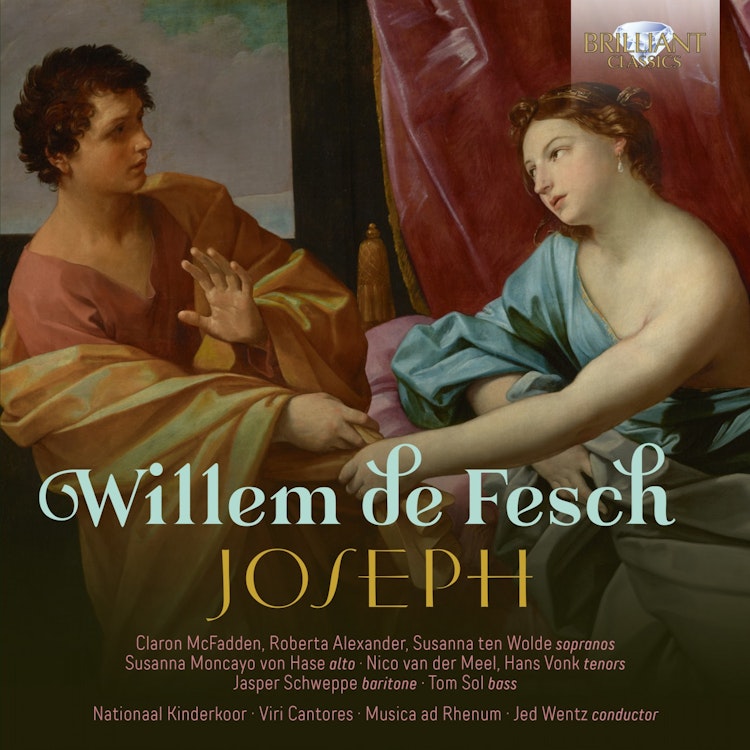
This recording of De Fesch's Joseph is based on a manuscript copy from the Royal Academy of Music in London and is the first album recording of the work.
Composition History
De Fesch's oratorio Joseph was first performed in 1745 at Covent Garden, just five days after Handel's Joseph and His Brethren had a reprise performance, suggesting a competitive relationship.
Interpretation
Conductor Jed Wentz enriched some arias with added winds playing colla parte with the strings, and filled out incomplete trumpet parts and added timpani, based on 18th-century orchestral practice.
Composer's Artistic Vision
The oratorio Joseph focuses on the themes of envy and forgiveness through faith in God, rather than the story of a hero or heroine.
Compositional Technique
Oratorios like Joseph are structured similarly to operas, divided into acts and scenes, with recitatives for narrative and arias for contemplative moments, often in da capo form.
Composer Biography
Willem de Fesch, the composer of this oratorio, was born in Alkmaar, North Holland, in 1687, but his parents were from Liege and returned there after his birth, so he received his musical education as a choirboy in Liege.
Composition History
The music for De Fesch's Joseph was long believed lost until Belgian musicologist Pieter Andriessen found a complete manuscript in the Royal Academy of Music in London in the 1980s.
You might also enjoy...
Haydn: Die Schöpfung/The Creation
Händel/Mozart: Der Messias
Handel: Israel in Egypt, HWV 54 (Arr. F. Mendelssohn)