The Leipzig Gewandhaus Orchestra, where Carl Reinecke dedicated his sonata to flutist Wilhelm Barge, deliberately maintained a traditional sound, using conical flutes with multiple keys rather than the newer cylindrical Böhm flutes.
Composer Biography
Sigfrid Karg-Elert, a student of Carl Reinecke, was advised by Edvard Grieg to study counterpoint and 17th and 18th-century dance idioms, leading Karg-Elert to describe Grieg as his "unforgettable master."
Composer Biography
Alexander von Zemlinsky, a teacher of Arnold Schoenberg, remained faithful to tonality and aimed for his music to always sound "beautiful."
Composer's Artistic Vision
The works on this recording are presented as products of a "golden age of security," a bourgeois culture that Stefan Zweig observed decaying with the rise of fascism and Nazism.
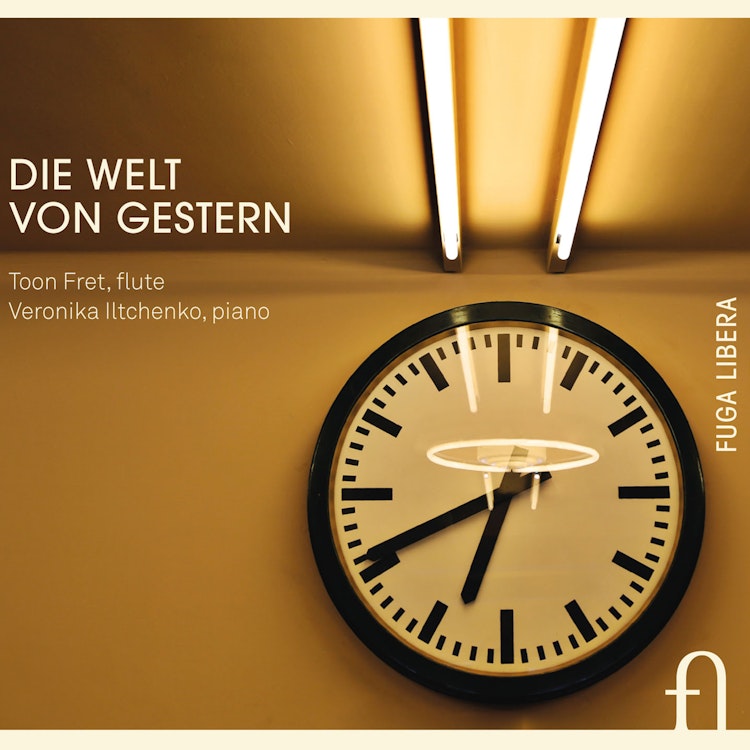
Album & Artwork
The album title, "Die Welt von Gestern" (The World of Yesterday), is taken from a memoir by Jewish-Austrian writer Stefan Zweig, who committed suicide in 1942.
Composition History
Robert Schumann composed his Drei Romanzen, Op. 94, in 1849, a year he described as his busiest, during which he composed around 40 works.
Interpretation
Although Schumann's Drei Romanzen, Op. 94, was originally for oboe (or violin/clarinet), the performers on this album chose to play it on the flute, assuming Schumann would not have objected.
You might also enjoy...
My Paris
Brahms Schumann Reinecke
Paris - French Flute Music
La flûte enchantée
The Complete Musical Heritage Society Recordings
Sounds of Lucerne
Révélations: Music for Flute & Piano by Boulanger, Camus, Bonis, Bertrand, Sancan, Jolivet
Flûte à la française
Gaubert: Complete Works for Flute and Piano
Compositrices : À l'aube du XXe siècle
Schocker, G.: For Dad / Poulenc, F.: Flute Sonata / Hindemith, P.: Flute Sonata