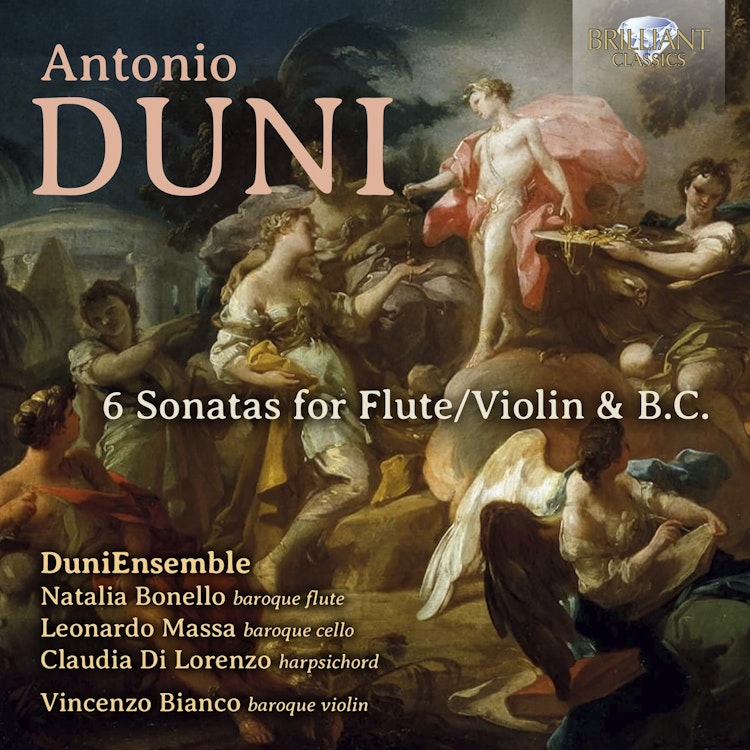
Antonio Duni, the composer, was born in Matera in 1700, a city that had become the capital of Basilicata by that time.
Compositional Technique
Antonio Duni's sonatas feature unusual harmonic solutions, daring chromatic progressions, and sudden changes of tonality, anticipating pre-Romantic suggestions.
Composition History
These six sonatas by Antonio Duni were discovered in 2019 by Professor Thomas Suarez, a descendant of the Duni family, in the Russian State Library in Moscow.
Composition History
The sonatas are dedicated to Mademoiselle Sandilands, daughter of George Sandilands, who was Antonio Duni's patron and for whom Duni was a singing and counterpoint master.
Composer Biography
Antonio Duni led a restless life, traveling extensively across Europe to cities like Barcelona, Vienna, Madrid, Paris, and even Moscow, where he founded the Moscow University Choir.
Composer Biography
Antonio Duni studied music in Naples, entering the Conservatory of the Pietà dei Turchini in 1710 to study composition with Fago and violin with Cailò.
Interpretation
The DuniEnsemble chose to perform the first three sonatas with baroque flute and the last three with baroque violin, as some sonatas particularly exploit the flute's sonority and 'vocality'.
You might also enjoy...
Scarlatti: La dirindina - Pur Nel Sonno
Officina Romana: A Wonder Lab at the Dawn of the 18th Century
Caught in Italian Virtuosity
D'Astorga & Lalli: Cantatas and Sonatas
Degli Antoni: 12 Sonatas, Op. 4
Locatelli: 4 Violin Sonatas from Op. 6
Vivaldi Collection 2 RV 6-10 the World Premiere Recording All Vivaldi Violin Sonatas Baltic Baroque / Maltizov
Viviani: Capricci armonici (Opera quarta)
Vivaldi: XII Suonate à violino solo, e basso per il cembalo
Geminiani: Violin Sonatas, Op. 4, Vol. 2
Vivaldi: "Manchester" Sonatas
Geminiani: Violin Sonatas, Op. 1
Italiane Baroque: Sonatas & Concertos
Telemann, G.P.: Essercizii Musici - Solos and Nos. 7-12