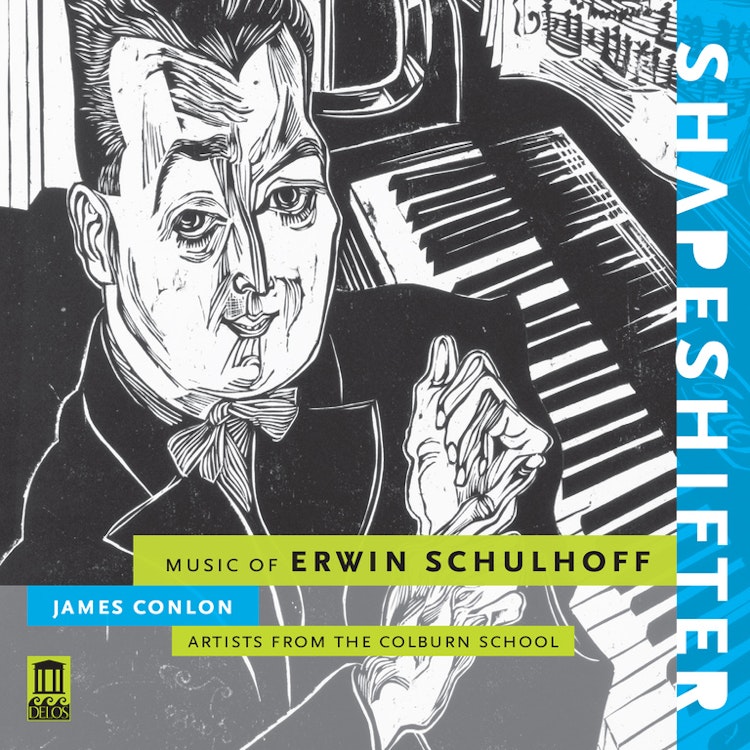
Erwin Schulhoff, born in Prague in 1894 to a German-speaking Jewish family, was encouraged to study piano by Antonín Dvořák.
Compositional Technique
One of Schulhoff's early pieces, 'In futurum' from 5 Pittoresken, Op. 31 (1919), consists entirely of rests, preceding John Cage's 4'33" by decades.
Recording & Production
This album was recorded as part of the Ziering-Conlon Initiative for Recovered Voices at the Colburn School, which promotes music by composers suppressed by the Nazi regime.
Composer Biography
As a Jew and a Communist, Schulhoff faced a dire future after Hitler's rise to power and died of tuberculosis in the Wülzburg Detention Camp in 1942.
Composer Biography
Schulhoff's experiences in World War I, including conscription into the Austrian army and time as a prisoner of war, profoundly influenced his artistic leanings.
Composer's Artistic Vision
After World War I, Schulhoff embraced the avant-garde, Dadaism, and jazz, moving away from neo-romanticism.
Album & Artwork
The album's title, Shapeshifter, refers to Erwin Schulhoff's ability to blend diverse musical ingredients like neo-folk, dance, jazz, and Dadaism with art music.
You might also enjoy...
Thomas Adès: In Seven Days
Thomas Adès: In Seven Days
Stanisław Wisłocki: Solo & Chamber Works
Scelsi: Suite 9 & 10 per pianoforte
Saint-Saëns: Piano Concertos Nos. 2 & 4/Poulenc: 3 mouvements perpétuels, etc.
Grigory Sokolov Plays Beethoven, Chopin, Schumann, Saint-Saëns, Brahms, Tchaikovsky
The Piano Music of Ralph Vaughan Williams
Finnissy: Piano Works
Bowen: 24 Preludes, Suite Mignonne & Berceuse, Op. 83
Franck - Oeuvres Pour Piano
Mirage: Piano Music by Stephen Dodgson
The Messenger
Saint-Saëns: Piano Concertos Nos 2, 5 & Piano Works