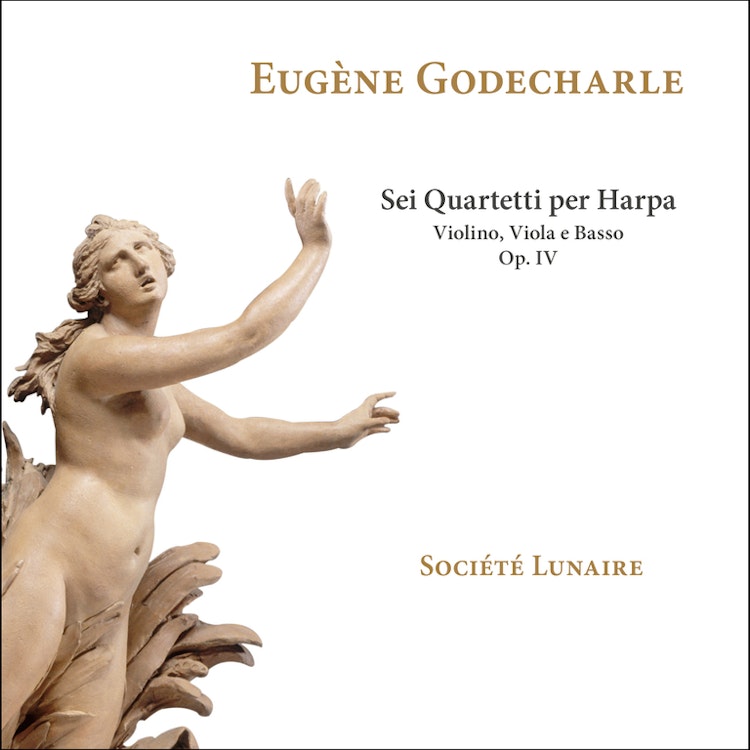
Eugène Godecharle: Sei quartetti per harpa, violino, viola e basso, Op. IV
10/27/2023, 18 Tracks, 1:13:23
Featuring
Maximilian Ehrhardt
Peter Barczi
Nadine Henrichs
Jule Hinrichsen
Société Lunaire
Eugène Godecharle
Did you know?
1/7
Compositional Technique
The quartets include typical 18th-century forms like rondos, allemandes, and minuets, alongside small fugues and one of the few surviving fully written-out cadenzas for violin and harp from that era.
Composer Biography
Godecharle received his initial musical training from his father, Jacques-Antoine Godecharle, who was a director of church music and a singer at the court of Prince Charles of Lorraine.
Compositional Technique
Godecharle's Sei Quartetti feature the violin and harp as solo instruments, but the viola and cello are not mere accompaniments; they enrich the tonal spectrum.
Instruments
The pedal harp, prominently featured in these quartets, was made widely known across Europe by the virtuoso harpist sons of its inventor, Jacob Hochbrucker.
Composer Biography
As a choirboy, Godecharle's exceptional talent for playing the violin was discovered, leading the Prince to send him to Paris for further artistic training.
Historical Context
Paris became the center of the harp world in the second half of the 18th century, attracting many musicians and makers, partly due to Queen Marie-Antoinette's personal interest in the instrument.
Composer Biography
Eugène Godecharle, the composer, was mistakenly identified as German by the renowned English music theorist Charles Burney, but he was actually born in Brussels.
You might also enjoy...
Reincken: Hortus musicus
Dall'Abaco, E.F.: Concerti for Strings - Opp. 2, 6
Concertos and Opera Overtures
Salvatore: Organ-Alternatim Masses
Weichlein: Messen
Dixerunt
Kuhnau: Neuer Clavier-Ubung, Vol. 1
Manfredini: Sinfonie da chiesa
Schweitzer: The Resurrection of Christ
Canti di Salomone a 3 parti
Telemann: Trios & Quartets with Transverse Flute and Viola da gamba