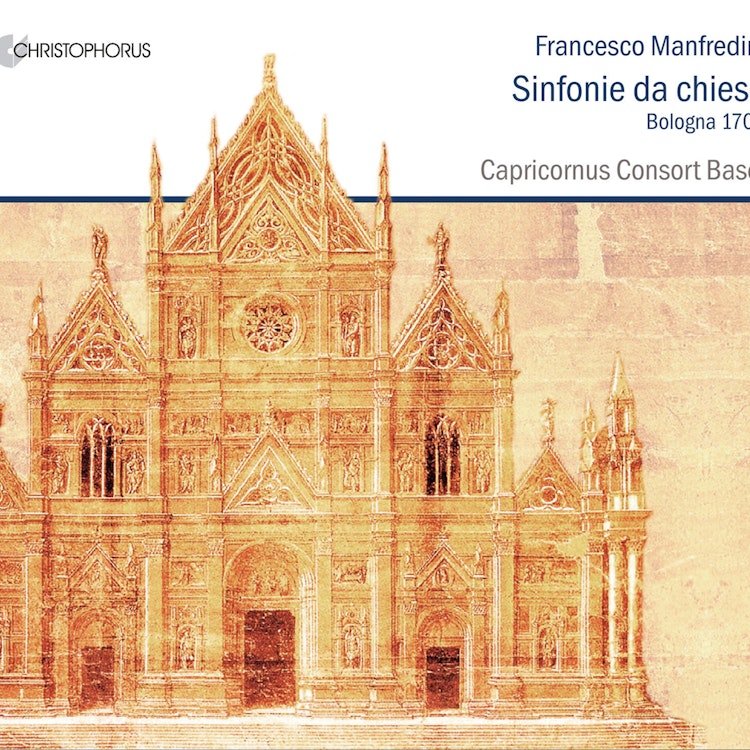
All pieces in the collection, except for the three-part Pastorale, consist of four movements and generally follow the slow/fast/slow/fast structure common in church sonatas.
Composition History
Manfredini's Sinfonie da chiesa, Op. 2, were first published in 1709 in Bologna and dedicated to the administrators of San Petronio, who paid him 100 lire for the printing.
Composer Biography
Francesco Manfredini came from a family that had been active in the musical life of Pistoia, a Tuscan city, for several generations.
Compositional Technique
The Sinfonie da chiesa could be performed in three different ways: as four-part ensemble pieces, as trio sonatas with two violins and continuo, or as concerti grossi with multiple players per part.
Critical Reception
Manfredini's Sinfonie da chiesa are considered unjustly neglected works that significantly enrich the repertoire of their period.
Composer Biography
Manfredini's father, Domenico Manfredini, was employed as a trombonist at Pistoia Cathedral for 42 years, starting in 1684.
Composer Biography
Francesco Manfredini studied composition with Giacomo Perti, chapel master at San Petronio in Bologna, and violin with Giuseppe Torelli and Bartolomeo Girolamo Laurenti.
You might also enjoy...
Concertos and Opera Overtures
Dall'Abaco, E.F.: Concerti for Strings - Opp. 2, 6
Telemann: Complete Horn Concertos for Horns, Strings & Basso Continuo
Telemann: Trios & Quartets with Transverse Flute and Viola da gamba
T. Albinoni: 12 Sonate a Tre Op. 3
Dixerunt
Telemann: VI Ouvertures à 4 ou 6 (1736)
Roman: The Swedish Virtuoso
Garth: Accompanied Keyboard Sonatas, Opp. 2 & 4
Kuhnau: Neuer Clavier-Ubung, Vol. 1
Jean-Marie Leclair: A Portrait, Sonatas and Dances