Peter Philips, another composer featured on this album, fled England as a young man because he was unable to comfortably maintain his Roman Catholic beliefs.
Composer Biography
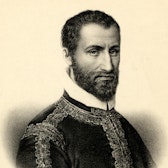
Palestrina, who wrote motets like Sicut cervus and Exultate Deo, served as choirmaster of St Peter's in Rome.
Recording & Production
This recording was made exactly one hundred years after the foundation stone of Westminster Cathedral was laid in 1895.
Historical Context
The English music on this album, including works by Robert Parsons and Christopher Tye, was a product of Queen Mary's short reign in the 1550s when Roman Catholicism briefly returned to England.
Historical Context
After Elizabeth I's accession, Latin motets by composers like Tallis and Byrd were not used in public worship and were instead designed for unofficial Roman Catholic gatherings.
Composer Biography
Tomás Luis de Victoria, a Spanish-born composer, wrote his motet O quam gloriosum while serving as organist at S. Maria di Monserrato, the Aragonese church in Rome.
Notable Performances
Gregorio Allegri's Miserere, written to be sung by the papal choir during Holy Week, is notable for its repeated use of a 'top C' and for being copied from memory by a 14-year-old Mozart.
You might also enjoy...
Sancte Deus
Sacred Voices
The Flowering of Genius
Miserere - Religious Choral Music
The Tallis Scholars: Perfect Polyphony
The Essential Tallis Scholars
A Watchful Gaze
Motets en espace
Passion & Resurrection: Music inspired by Holy Week