The title 'Lebensstürme' (Storms of Life) for Schubert's Allegro in A minor D 947 was added by the publisher Anton Diabelli, not by Schubert himself.
Composition History
While in Hungary, Schubert was inspired by Hungarian Gypsy melodies, leading him to compose the Divertissement à l'hongroise D 818 and the Hungarian Melody D 817.
Composition History
Schubert's Fantasia in F minor D 940 was dedicated to Karoline Esterházy, a young noblewoman he taught music to during his summers at her family's estate in Hungary.
Compositional Technique
The German word 'Fantasie' has a double meaning, deriving from both 'fantasieren' (to improvise) and 'Fantasie' (imagination), which is a recurrent idea in romantic art.
Composer's Artistic Vision
Schubert often used the term 'fantasy' to designate a piece that retains the four traditional sections of a sonata or symphony but shortens and combines them within a single movement with unexpected transitions.
Compositional Technique
The opening of Schubert's Piano Sonata in G major D 894 features a simple pianissimo chord whose resonance is prolonged indefinitely by a grace note, a technique anticipating Schumann.
Composer's Artistic Vision
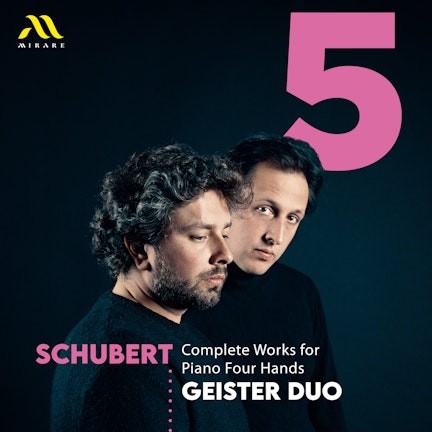
Schubert was the first to elevate piano music for four hands from its amateur, domestic origins to the level of true chamber music.
You might also enjoy...
Schubert: Works for Piano Duet and Piano Solo
Schubert: Impromptus & Fantasie
Schubert: Piano Works, Trout Quintet, Lieder
Schubert: Sonata in C Minor, D. 958, 4 Impromptus, D. 935 & Rondo, D. 951