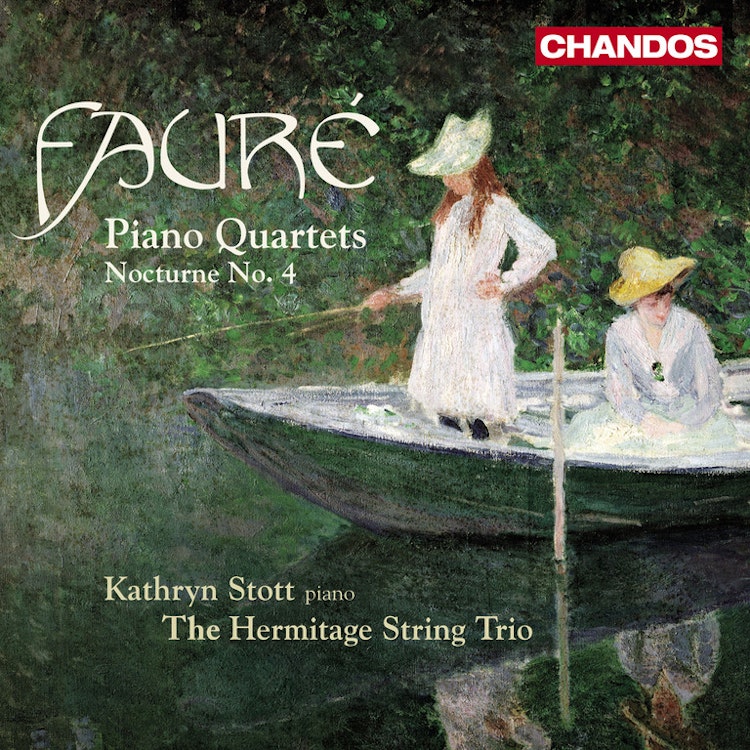
Faure, G.: Piano Quartets Nos. 1 and 2 / Nocturne No. 4
2/23/2010, 9 Tracks, 1:11:50
Featuring
Kathryn Stott
Boris Garlitsky
Alexander Zemtsov
Leonid Gorokhov
Hermitage String Trio
Gabriel Fauré
Did you know?
1/7
Historical Context
The Société nationale de musique, founded in Paris in 1871, was crucial for French music, promoting 'serious musical works' of 'elevated aspirations and truly artistic' quality.
Composition History
Fauré's Piano Quartet No. 1 originally had a different finale, which his friends did not appreciate, leading him to compose a new one in 1883.
Composer Biography
In 1879, Gabriel Fauré, at 34, was choirmaster and second organist of the Madeleine church, giving piano lessons to young ladies in the Paris suburbs to supplement his income.
Historical Context
The 'elevation' standard for French music at the time was German music, with composers like Mozart, Beethoven, Schumann, and Brahms influencing budding French composers.
Composer's Artistic Vision
Fauré rarely revealed the inspiration behind his music, but he explicitly stated that the Adagio of his Piano Quartet No. 2 was inspired by childhood memories of distant church bells.
Performer Biography
Kathryn Stott, the pianist on this recording, was appointed Chevalier dans l'Ordre des Arts et des Lettres by the French Government for her artistic vision in festivals like 'Fauré and the French Connection'.
Performer Biography
The Hermitage String Trio, founded in 2004, is a European-based Russian trio whose members have performed with renowned musicians such as Yehudi Menuhin, Martha Argerich, and Gidon Kremer.
You might also enjoy...
Fauré Quartett
Fauré: The Two Piano Quartets
Fauré: Piano Quintet No. 1; Piano Quartet No. 1
Fauré: Requiem
Fauré : Piano Quintets & Piano Quartets
Gabriel Fauré: Requiem
Messe de Requiem, Op. 48/N 97b
Fauré: Requiem in D Minor, Op. 48
Fauré: Requiem
Fauré: Berceuse, Op. 16 (Version for Violin and Orchestra)