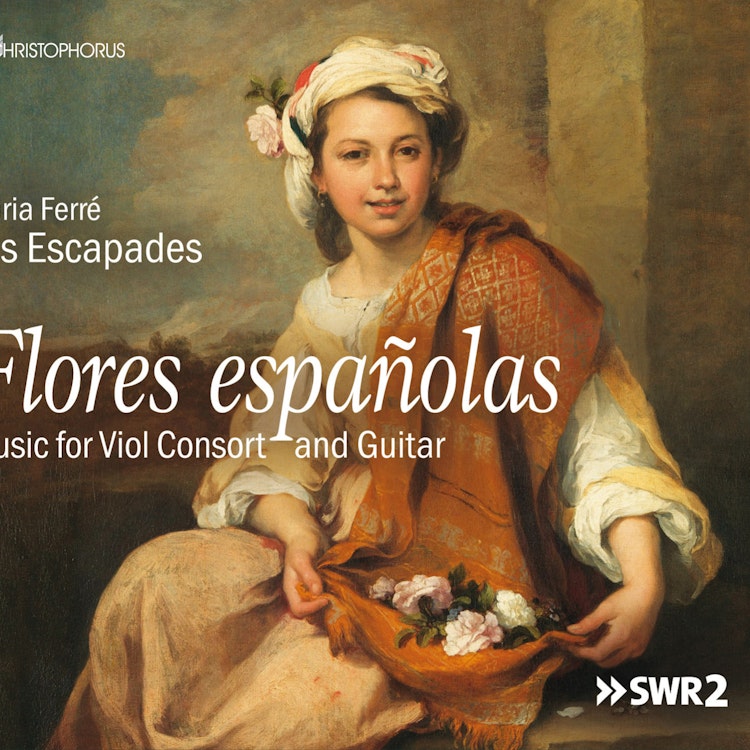
Flores españolas: Music for Viola Consort & Guitar
2/16/2018, 22 Tracks, 1:02:27
Featuring
Maria Ferré
Sabine Kreutzberger
Adina Scheyhing
Barbara Pfeifer
Franziska Finckh
Les Escapades
Luis de Milán
Pablo Bruna
Gaspar Sanz
Diego Ortiz
Antonio de Cabezón
Juan del Encina
Sebastián Aguilera de Heredia
Francisco de la Torre
Anonymous
Juan Cabanilles
Santiago de Murcia
Did you know?
1/7
Instruments
The viols, or 'Vihuele de arco', evolved from the 'Vihuela da mano', an early form of the Spanish guitar, highlighting the guitar's central role in Spanish music.
Composition History
In 1626, Francisco Correa de Arauxo, an organist and composer, published "Facultad Organica," a collection of 69 organ pieces from earlier times and by Spanish contemporaries, along with theoretical and practical instructions.
Composition History
Gaspar Sanz, one of the first known guitar composers, published his "Instrucción de música sobre la guitarra española" in 1674, which contained typical Spanish dances and went through eight editions.
Interpretation
Les Escapades, the ensemble on this album, decided to perform organ works by Pablo Bruna on viol consort because the organs' mid-tone tuning can be realized on viols using split frets.
Historical Context
The 16th and 17th centuries in Habsburg Spain, known as the "Siglo de Oro" (Golden Century), were a period of rich artistic flourishing, bridging the Renaissance and Baroque eras.
Instruments
Pablo Bruna, an organist from Daroca, was blind, similar to Antonio de Cabézon, a musician at the Spanish Habsburg court in Madrid, and was known as 'El Ciego de Daroca' (The Blind Man of Daroca).
Compositional Technique
Diego Ortiz, considered the first Spanish viol composer, published "Tratado de Glosas," one of the oldest treatises on diminution and ornamentation, which includes examples for solo playing over dance rhythms.
You might also enjoy...
Bach: Wo soll ich fliehen hin
Bigaglia: VII Sonate per flauto dolce e basso continuo
Sances, Bertali & Schmelzer: Stabat Mater
Æternum: Music of the Elizabethan Avant Garde from Add. MS 31390
J. Ward: Consort Music
Viola Da Gamba Recital: Dornenburg, John - Hume, T. / Sainte-Colombe, J. / Simpson, C. / Kuhnel, A. / Abel, C.F.