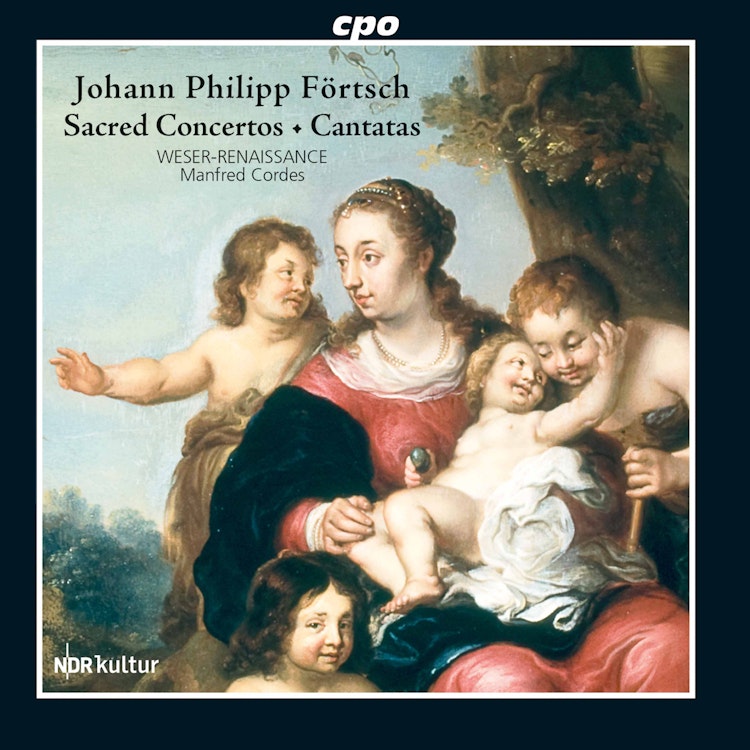
The court chapel of the Dukes of Schleswig-Holstein-Gottorf was one of the leading ensembles in the 17th century, flourishing even during the Thirty Years' War due to the duke's neutrality.
Performer Biography
WESER-RENAISSANCE Bremen, led by Manfred Cordes, is an internationally renowned ensemble specializing in 16th and 17th-century music, known for discovering and performing hidden musical treasures.
Compositional Technique
Förtsch integrated dramatic operatic elements into his sacred music, transforming gospel texts into 'little sacred dramas' with clear 'roles' for different voices, similar to an oratorio.
Composer Biography
Johann Philipp Förtsch, the Gottorf Chapel Master from 1680-1684, was a versatile figure who worked as an opera singer, librettist, composer, personal physician, and diplomat, and even managed government affairs for a time.
Instruments
The Gottorf Castle Chapel's organ, with its richly carved casing from 1567, was restored to its 17th-century disposition and now sounds as a court organ of the early Baroque.
Composer's Artistic Vision
Förtsch's musical approach combined courtly performance, the transfer of opera experience to sacred music, and the use of church songs, which prepared the way for the 18th-century cantata.
Recording & Production
This recording features compositions on the largest imaginable scale, including court trumpeters, and aims to recreate the 'tonal magic' of the original setting in the Gottorf Castle Chapel.
You might also enjoy...
Cazzati: Amor Profano, Amor Sacro, Secular and Sacred Vocal Music
Österreich: Psalms & Cantatas
Rosenmüller: In te Domine speravi
Das Leiden Jesu: Passion Cantatas, Vol. 3
Pfleger: Sacred Cantatas
¡Ay Amor! Spanish 17th Century Songs & Theatre Music
Torri: La Vanità del mondo
Dattari: Le Villanelle a tre, a quattro e a cinque voci
Llibre Vermell de Montserrat
Graupner: Das Leiden Jesu
Zapf: Das goldene Kalb
The Night of Saint Nicholas. A Mediaeval Liturgy for Advent