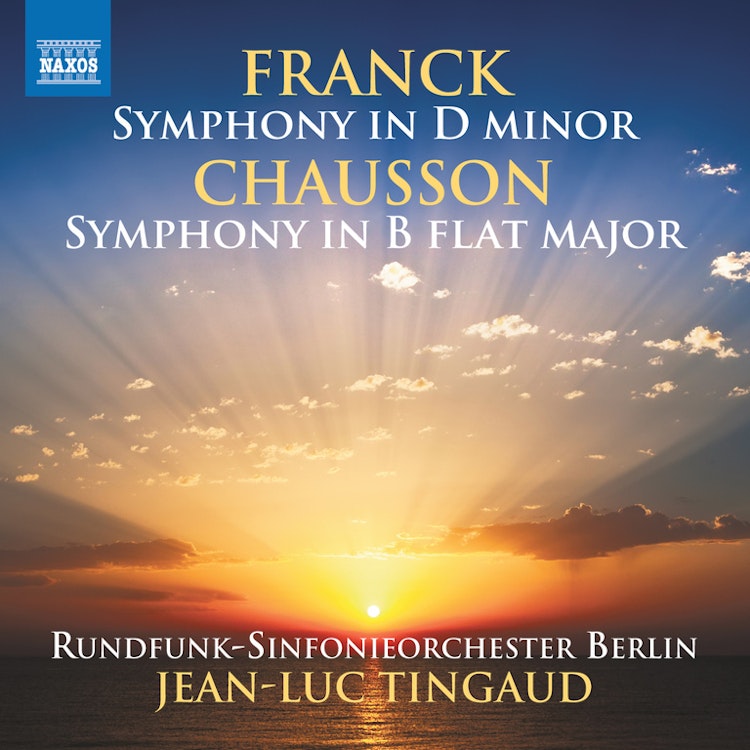
Franck: Symphony in D Minor, FWV 48 - Chausson: Symphony in B-Flat Major, Op. 20
1/12/2024, 6 Tracks, 1:11:58
Featuring
Jean-Luc Tingaud
Rundfunk-Sinfonieorchester Berlin
César Franck
Ernest Chausson
Did you know?
1/7
Critical Reception
Franck's Symphony in D minor was not a success at its 1889 premiere but rose to fame in 1893 at the Concerts Lamoureux, a venue sympathetic to its rich orchestral textures and chromatic harmony.
Composer Biography
César Franck died one year after the premiere of his Symphony in D minor after being struck by a horse-drawn carriage; his pupil Ernest Chausson also died in a transport-related accident nine years later.
Compositional Technique
Franck's Symphony in D minor uses an innovative cyclic form, where themes from earlier movements are recalled later, treating a central three-note motif as completely malleable material.
Historical Context
The founding of the Société nationale de musique in 1871, which included Franck, aimed to promote new French instrumental music to rival the German-Austrian tradition, following France's defeat in the Franco-Prussian War.
Composition History
César Franck, a Belgian-born composer, organist, and teacher who became a French citizen, began his first and only symphony at the age of 64 in 1887.
Recording & Production
The original manuscript of Franck's Symphony in D minor was destroyed in a fire in 1935, making the accuracy of its published score, engraved by the renowned German firm Röder, particularly valuable.
Interpretation
The conductor, Jean-Luc Tingaud, meticulously corrected major errors in the published score and parts of Chausson's Symphony in B flat major by studying the composer's manuscripts.
You might also enjoy...
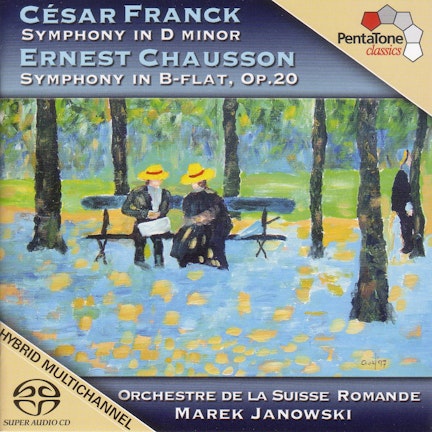
Franck & Chausson : Symphonies
Nielsen: Symphonies Nos. 1 & 3
Nielsen: Symphonies 2 & 3
Nielsen: Symphonies Nos. 3 & 4
Franck: Symphony in D Minor / Chausson: Symphony in B-Flat Major
Bruckner / Sibelius / Nielsen
Bruckner: Symphonies Nos. 3 & 8
Antonín Dvořák: Symphonies No. 3 & No. 7
Dvorák: Symphony No.3 In E Flat, Op.10, B. 34 & Symphony No.7 In D Minor, Op.70, B. 141