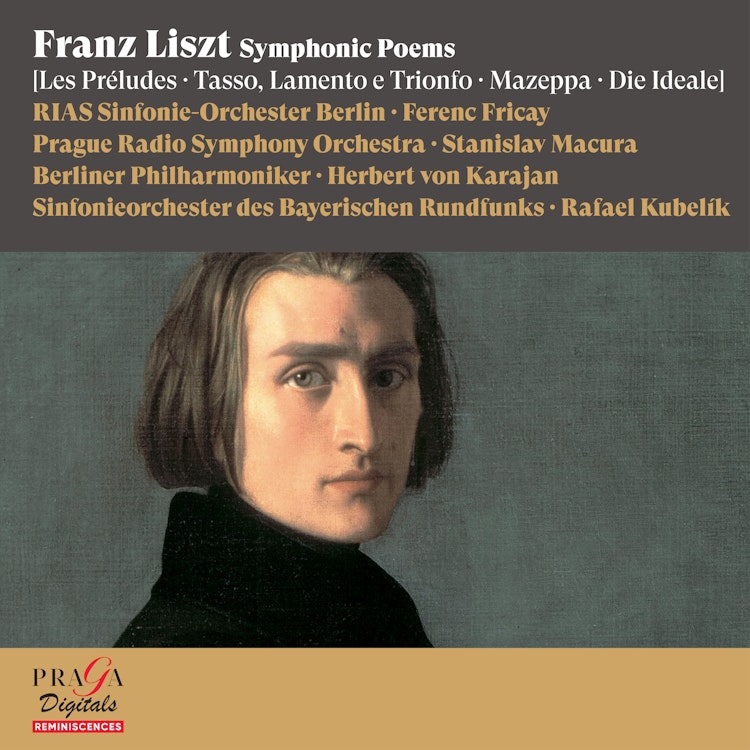
Franz Liszt: Symphonic Poems (Les Préludes, Tasso - Lamento e Trionfo, Mazeppa, Die Ideale)
5/1/2017, 4 Tracks, 1:19:56
Featuring
Ferenc Fricsay
Stanislav Macura
Herbert von Karajan
Rafael Kubelík
RIAS-Symphonie-Orchester Berlin
Prague Radio Symphony Orchestra
Berliner Philharmoniker
Symphonieorchester des Bayerischen Rundfunks
Franz Liszt
Did you know?
1/7
Composer's Artistic Vision
Liszt's symphonic poems aimed to move beyond the 'abstract' forms of classicism, like the sonata form, to prioritize expression and connect musical form to a poetic idea.
Performer Biography
Herbert von Karajan, one of the conductors on this album, was the principal conductor of the Berlin Philharmonic for 35 years and is considered one of the greatest conductors of the 20th century.
Performer Biography
Rafael Kubelík, another conductor featured, was the music director of the Chicago Symphony Orchestra, The Royal Opera, Covent Garden, and the Bavarian Radio Symphony Orchestra.
Compositional Technique
Liszt's fresh approach to orchestral writing, particularly his unusual and exposed combinations of instruments, was considered avant-garde in his time.
Composer Biography
Franz Liszt, the great Hungarian composer, is often remembered primarily as a piano virtuoso, but he was also immensely active in orchestral music.
Composition History
Liszt is credited with creating the symphonic poem, a musical genre that uses an external poetic, descriptive, or philosophical argument to determine its conception and structure.
Compositional Technique
A common innovation in Liszt's symphonic poems is the use of a basic theme that reappears throughout the work in various forms and combinations.
You might also enjoy...
Liszt: Symphonic Poems 4-7
Liszt: Orchestral Works, Vol. 1. The Weimar Symphonic Poems: Les préludes, Mazeppa, Prometheus...
Bax: Spring Fire, Symphonic Scherzo & Northern Ballad No. 2
Smetana: Vltava (The Moldau); Mussorgsky: Night on the Bare Mountain; Liszt: Les Préludes; Sibelius: Valse triste