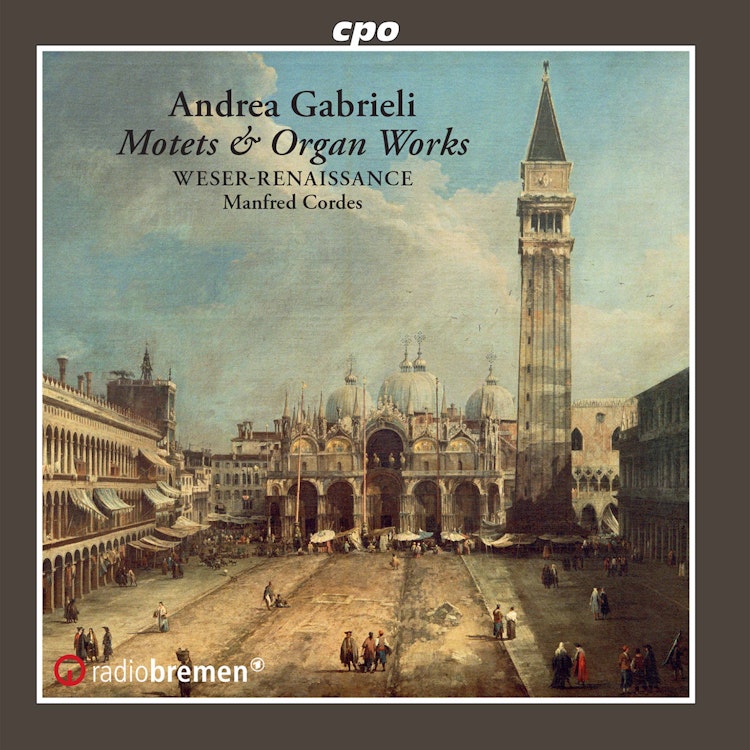
Andrea Gabrieli, a composer on this album, initially failed to secure an organist position at St. Mark's Basilica in Venice, leading him to leave the republic before eventually returning to take up the post.
Historical Context
St. Mark became the patron saint and symbol of Venice around 828 AD, replacing the former patron Saint Theodor, and was indispensable to the political system.
Composer Biography
Andrea Gabrieli, a composer featured on this album, was born in Venice in 1533 or 1534 and was responsible for his nephew, Giovanni Gabrieli, after his father's death.
Composer's Artistic Vision
Andrea Gabrieli's works, distributed by his German pupils Gregor Aichinger and Hans Leo Hassler, were influential in Germany and helped advance instrumental music and polychoral writing.
Compositional Technique
The Basilica of San Marco in Venice, where Andrea Gabrieli worked, featured numerous galleries used as performance venues for orchestral music, and by the 16th century, housed two organs by different builders.
Historical Context
Venice, where this music was created, was built on swamps and islands, not on ancient ruins like other Italian cities, and grew into a world power.
Instruments
Organs of Andrea Gabrieli's time typically had one manual and pedals with 10-15 keys, which were coupled to the manual, meaning no independent pedal register existed.
You might also enjoy...
Jan PieterszoonSweelinck: Pseaumes de David
Sweelinck: The Complete Psalms
Bach, J.S.: Christmas Music
Frauenkirche Dresden. Vom Himmel hoch. Weihnachtliche Musik von Johann Sebastian Bach
Inspirations
The Anglo-American Classic Organ
Liszt, Ives & Others: Keyboard Works
The Forgotten Gem
Nordic Journey, Volume 13
Organ Recital: Diaz, James - Cooke, J. / Reincken, J. / Bach, J.S. / Dupre, M. / Langlais, J. / Vierne, L. / Franck, C. (Organ Classics)
Organ Recital: Nolan, Joseph – Boellmann, L. / Elgar, E. / Thalben-Ball, G. / Liszt, F.