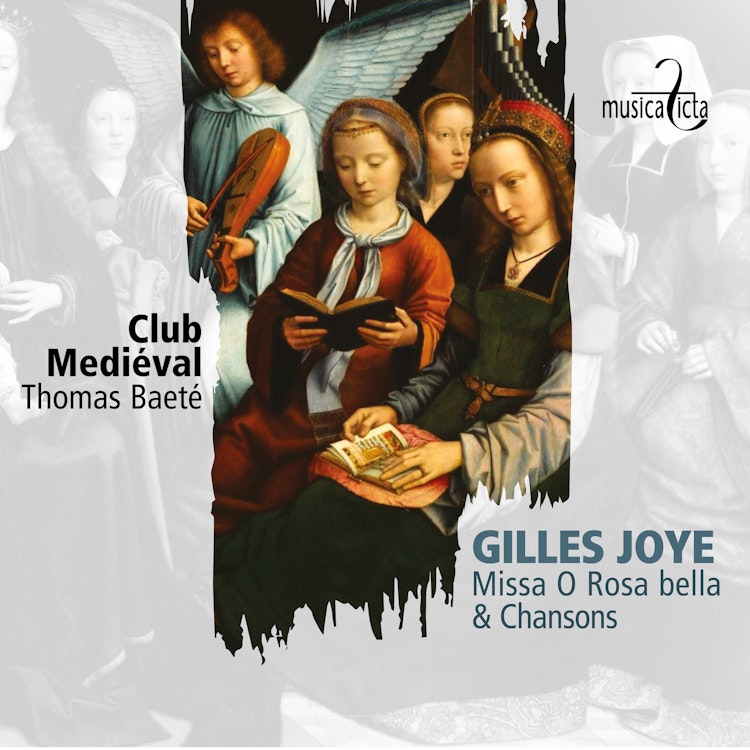
The two 'O Rosa bella' masses on this album, found in the Lucca Choirbook, are attributed to Joye based on stylistic characteristics and are written on a well-known song by the Englishman Bedyngham.
Composer Biography
Gilles Joye's financial mismanagement led to his bankruptcy in 1474, forcing him to flee Bruges and resulting in the auction of his possessions, including diamond-studded rings and a marten fur-lined tunic.
Instruments
The clavicymbalum on this recording was made in 2015 by Jean-Luc Wolfs-Dachy, modeled after an instrument by Arnaut de Zwolle from the 15th century.
Compositional Technique
One of Gilles Joye's most popular songs, 'Ce qu'on fait à catimini,' is characterized by its obscene content, which seems to be directly inspired by his own dissolute life.
Composer Biography
Gilles Joye, a 15th-century composer, was considered one of the greats of his time, even listed among illustrious colleagues like Guillaume Dufay and Gilles Binchois by French poet Guillaume Crétin.
Cultural Impact
Gilles Joye's portrait by Hans Memling, the greatest painter in Bruges at the time, is the oldest known portrait of a composer.
Composer Biography
Despite being a priest, Gilles Joye was known for a dissolute lifestyle, including composing satirical verses about colleagues, street brawls, frequenting brothels, and having a concubine named Rosabella.
You might also enjoy...
Origins
Banchieri: Barca di Venetia per Padova
Flora Gave Me Fairest Flowers - Elizabethan Madrigals