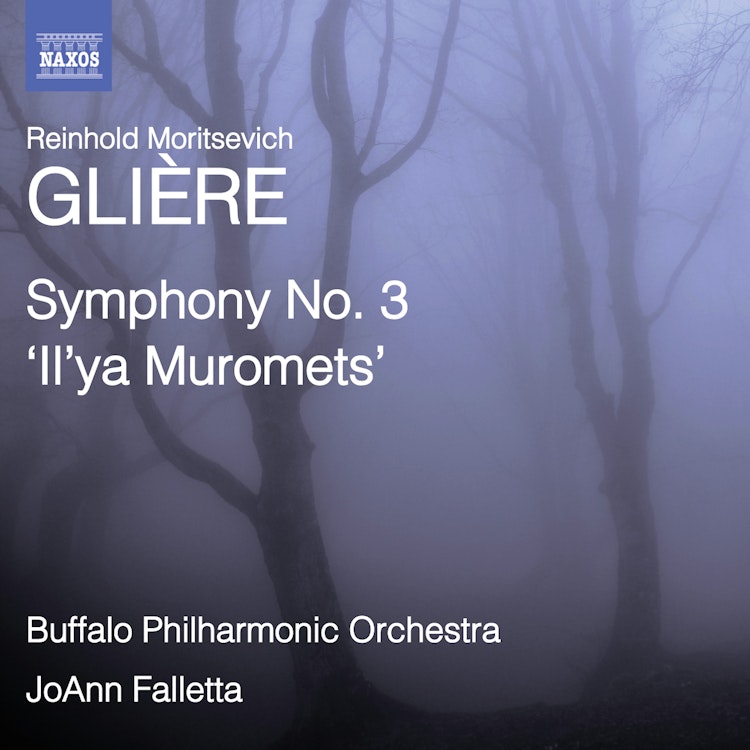
Reinhold Glière, the composer, was born in Kiev in 1875 and studied composition at the Moscow Conservatory with notable teachers like Arensky, Ippolitov-Ivanov, and Taneyev.
Composer's Artistic Vision
Glière's Symphony No. 3, 'Il'ya Muromets', is a prime example of his lifelong interest in composing music on national themes based on mythology and popular lore.
Recording & Production
This recording of Glière's Symphony No. 3 was performed and recorded uncut to preserve the composer's extraordinary architecture.
Compositional Technique
Glière's Symphony No. 3 is scored for a robust orchestra with expanded woodwinds and brass, including eight horns, two harps, celeste, full strings, and extended percussion.
Critical Reception
Glière's Symphony No. 3 is considered a 'cult piece' and the composer's towering masterpiece, but it is rarely played in concert due to its length and enormous instrumental requirements.
Performer Biography
JoAnn Falletta, the conductor, serves as Music Director of the Buffalo Philharmonic and Virginia Symphony, and Principal Conductor of the Ulster Orchestra in Northern Ireland.
Compositional Technique
To leave no doubt about the sonic metaphor of each movement, Glière added a long narrative to the score in both Russian and French.
You might also enjoy...
Tchaikovsky: Symphony No. 5 in E Minor, Op. 64
Tchaikovsky: Symphony No.6 "Pathétique"
Tchaikovsky: Symphony No. 4
Rachmaninov: Symphony No. 2
Miaskovsky: Symphony No. 6, Op. 23
Prokofiev: Symphonies Nos. 2 & 6
Tschaikowsky: Symphonien No. 4, 5 & 6 Pathétique
Tchaikovsky: Symphony No. 4 in F Minor, Op. 36, TH 27
Taneyev, S.I.: Symphonies Nos. 1 and 3
Symphony No. 6 in B Minor, Op. 74, "Pathetique": II. Allegro con grazia