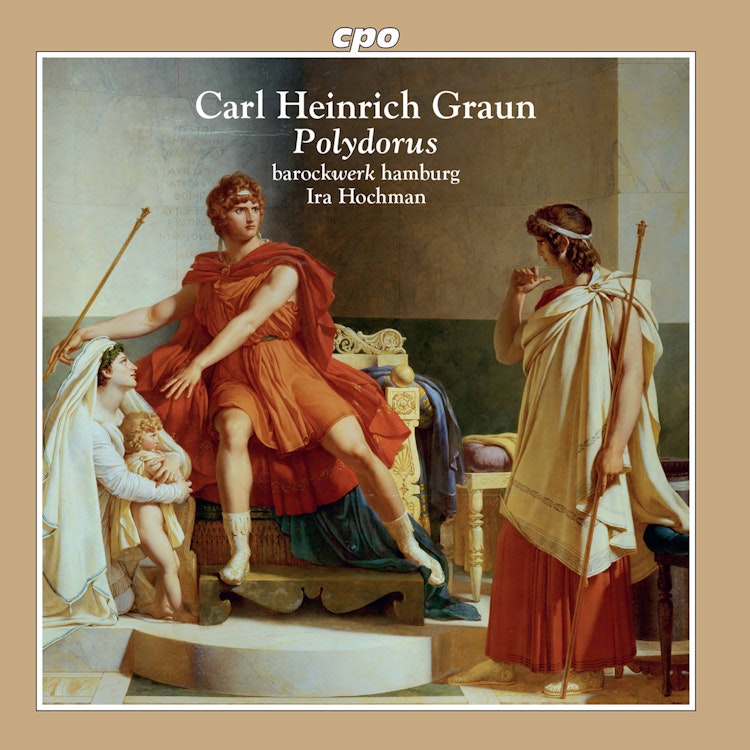
In 1898, a critic declared Carl Heinrich Graun's operas "dead and will never return to life," a judgment this recording aims to refute.
Historical Context
Graun's German operas, despite their quality, were largely forgotten because Italian operas dominated German stages outside of Braunschweig and Hamburg at the time.
Recording & Production
This recording of Polydorus is the first, featuring a dramaturgically abridged version, and was performed for the first time in 2018 at the Hamburg State and University Library.
Composer's Artistic Vision
Johann Georg Sulzer, a contemporary, noted that Graun's style was characterized by a "soul filled with tenderness, gentleness, and pleasantness," resulting in bright, clear, and melodious music.
Composition History
Graun's opera Polydorus is a German setting of a libretto by Johann Samuel Müller, which itself was based on an Italian libretto by Agostino Piovene, ultimately derived from Euripides' Hecuba.
Compositional Technique
Graun's music for Polydorus is described as stylistically more mature, richly instrumented, and more precise in characterization compared to an earlier setting of the same libretto by Antonio Lotti.
Composer Biography
Carl Heinrich Graun, the composer, began his career as a choirboy and received extensive musical training on various instruments and in composition.
You might also enjoy...
Purcell: King Arthur
Monteverdi: Il ritorno d'Ulisse in patria, SV 325
Steffani: Orlando Generoso
Campra: Idoménée
Marais: Ariane et Bacchus
Handel: Agrippina
Purcell: Dido and Aeneas
Monteverdi, C.: Orfeo (L') [Opera]
Handel: Faramondo, HWV 39
Steffani: Baccanali (Live)
Monteverdi : Il ritorno d'Ulisse in patria [Highlights]