Hakenberger's motets frequently use the cori spezzati technique, employing two or three choirs, often with contrasting registers, and are enhanced by instrumental accompaniment.
Composition History
Hakenberger's appointment as chapel-master at St Mary's in Gdańsk was secured because his polychoral output in the Venetian style was highly regarded, with artistic arguments prevailing over religious concerns.
Recording & Production
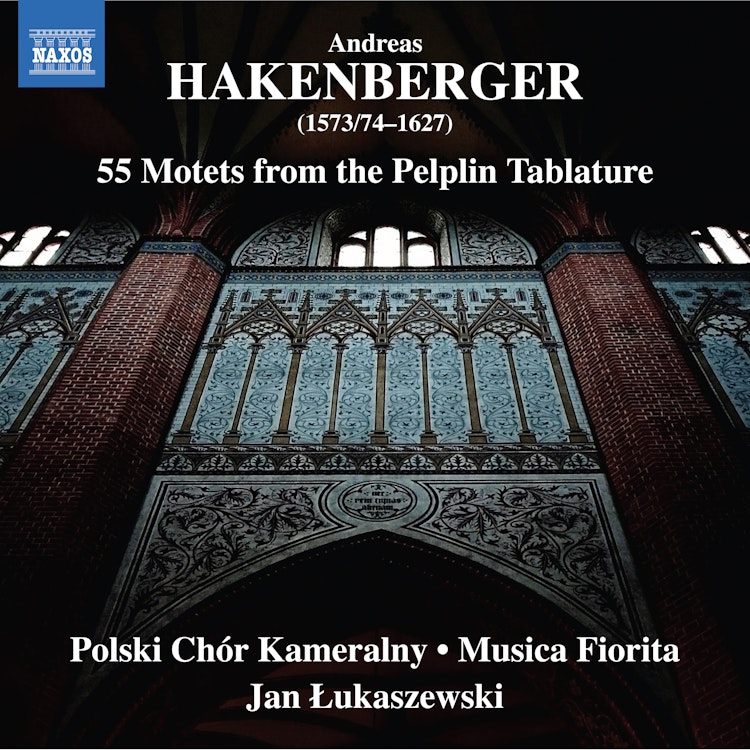
This album features a world premiere recording of 55 motets by Andreas Hakenberger from the Pelplin Tablature.
Compositional Technique
Hakenberger's motets incorporate musical rhetoric, such as general pauses to emphasize words and triple metre to reflect a cheerful mood, as well as illustrative effects like falling or rising motifs.
Composer Biography
Andreas Hakenberger, a Catholic, was appointed chapel-master at the Lutheran Church of St Mary's in Gdańsk in 1608, after councillors debated entrusting liturgical music to a 'papist'.
Composer Biography
Andreas Hakenberger spent his entire professional career within the territory of the Crown of the Kingdom of Poland, including Kraków, possibly Warsaw, and Gdańsk.
Instruments
Hakenberger's motets were intended to be accompanied by various instruments, including violin, viol, lute, theorbo, cornett, dulcian, trombone, and organ, which shaped his musical imagination.
You might also enjoy...
Beer: Missa S. Marcellini (Ursus Murmurat)
Tobias Hume: Musical Humors
Colonna: Il Transito di San Gioseppe
Bodinus: Divertissements
Manuscrit Susanne van Soldt: Danses, chansons & psaumes des Flandres, 1599
Landsgemeindekantate «Alles Leben strömt aus dir»
Eccard: Sacred Songs
Johannes Eccard: Preussische Festlieder
Salvolini: Missa defunctorum - Missa brevis in G major - Mass in D major - Motets - Hymns
Voice of the Soul - Flute Music by Jean Daniel Braun