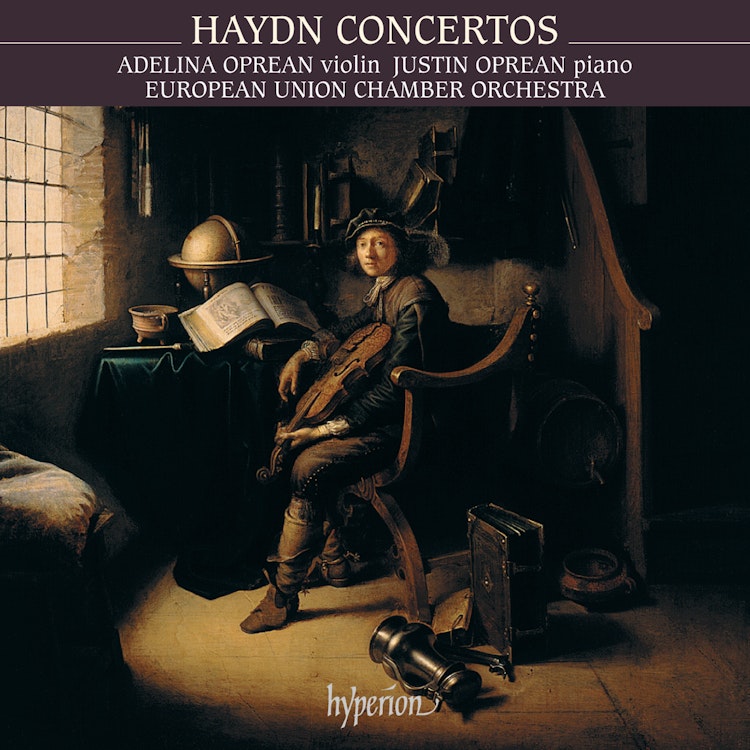
Haydn: Concertos for Violin & for Violin and Piano
2/16/2024, 9 Tracks, 1:01:20
Featuring
Justin Oprean
Adelina Oprean
European Union Chamber Orchestra
Joseph Haydn
Did you know?
1/7
Composer's Artistic Vision
Haydn's violin concertos show the clear influence of Italian concertos, particularly those of Vivaldi, in their scoring for strings, ritornello form, and ornate slow movements.
Composer Biography
Haydn began writing concertos around 1756, when he was in his mid-twenties and working as a freelance musician in Vienna.
Composition History
Haydn's Concerto in F major was written for his sister-in-law when she took the veil in 1756, an event that held great emotional significance for the composer due to an unhappy love affair.
Compositional Technique
The first movement of Haydn's double concerto exemplifies a mid-18th century variant of the Baroque concerto form, featuring alternating orchestral ritornellos and solo passages with modulations.
Performer Biography
Adelina Oprean, the violinist on this recording, studied with Yehudi Menuhin and Sándor Végh, and has won first prizes at international competitions in Colmar (1977) and London (1982).
Composition History
The Concerto in C major was marked 'fatto per Luigi' in Haydn's catalogue, referring to Luigi Tomasini, the leader of the Esterházy family's private orchestra, for whom Haydn was deputy Kapellmeister.
Historical Context
The solo concerto was only recently established in Austria in the 1750s, as Viennese Baroque composers like J.J. Fux and Antonio Caldara focused mainly on vocal music.
You might also enjoy...
Frank-Peter Concertos
Great Moments of Anne-Sophie Mutter
Best of Anne-Sophie Mutter
Sublime Mutter !
The Art of Anne-Sophie Mutter
Isaac Stern - A Life in Music: Box Set I
Mozart: Violin Concerto No. 5 / Mendelssohn: Violin Concerto in D Minor
Haydn, J.: Violin Concerto in G Major / Haydn, M.: Violin Concerto in B-Flat Major / Mozart: Adagio
Legend
Queen of the Violin
Bruch, Mendelssohn, Mozart Violin Concertos
Inner Thoughts
The Heifetz Collection Vol. 11-15 - The Concerto Collection