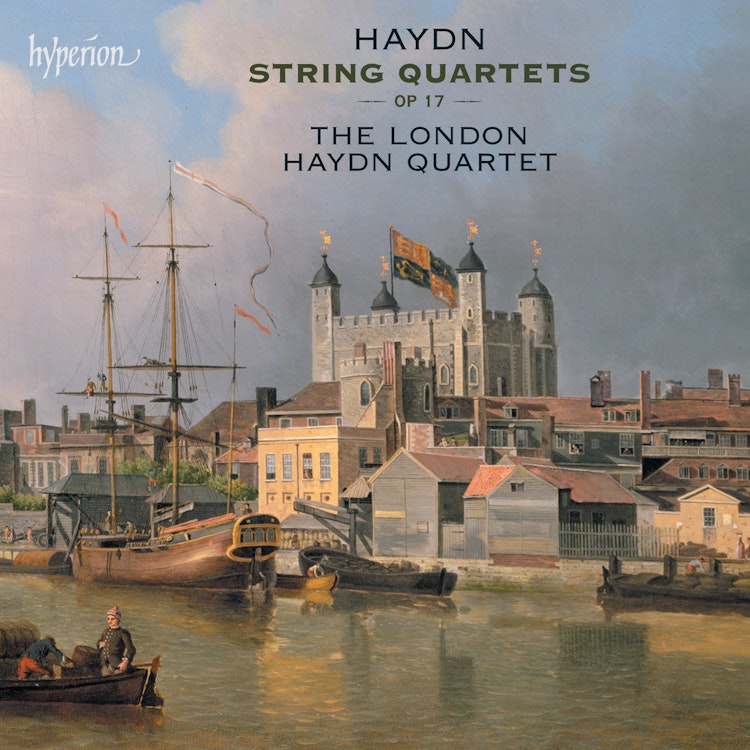
After his initial quartet compositions, Haydn, the 'father of the string quartet', composed no more works in the medium for a decade, focusing instead on symphonies, opera, church music, and baryton music for Prince Nicolaus Esterházy.
Recording & Production
For this recording, the London Haydn Quartet chose to perform from an 18th-century London edition published by Welcker around 1774, rather than a modern edition.
Composition History
Joseph Haydn 'stumbled' into the string quartet form by composing Divertimenti a quattro for summer music parties at the estate of his early patron, Carl Joseph von Fürnberg.
Historical Context
The presence of virtuoso violinist Luigi Tomasini, leader of the Esterházy orchestra, was crucial to Haydn's renewed focus on string quartets, with Haydn himself playing second violin.
Composer Biography
Haydn's early quartets, published as Op 1 and Op 2, circulated rapidly throughout Europe in manuscript and unauthorized printed copies, sowing the seeds of his international fame.
Interpretation
The London Haydn Quartet plays on gut strings with classical bows, aiming to preserve the freedom and spontaneity of 18th-century performance practices.
Composer's Artistic Vision
Haydn himself later stated that he wanted his catalogue of quartets to begin only with Op 9, indicating a shift in his artistic view of the genre.
You might also enjoy...
Mozart: String Quartets No. 22 & 23
Haydn: String Quartets Vol. 2
Haydn: Die sieben letzten Worte unseres Erlösers am Kreuze
The Auryn Series, Vol. 30
Haydn: String Quartets Op. 71, Apponyi Quartets
Haydn: String Quartets Vol. 4
Haydn: Prussian Quartets, Op. 50 Nos. 1-3 (On Period Instruments)
Haydn: String Quartets, Op. 9
Haydn: String Quartets Op. 42 and Op. 2, Nos 4 and 6
Haydn: Complete String Quartets, Vol. 1/3
Haydn: String Quartets, Op. 17
Haydn: String Quartets Nos. 23, 24 and 27, 'sun Quartets'