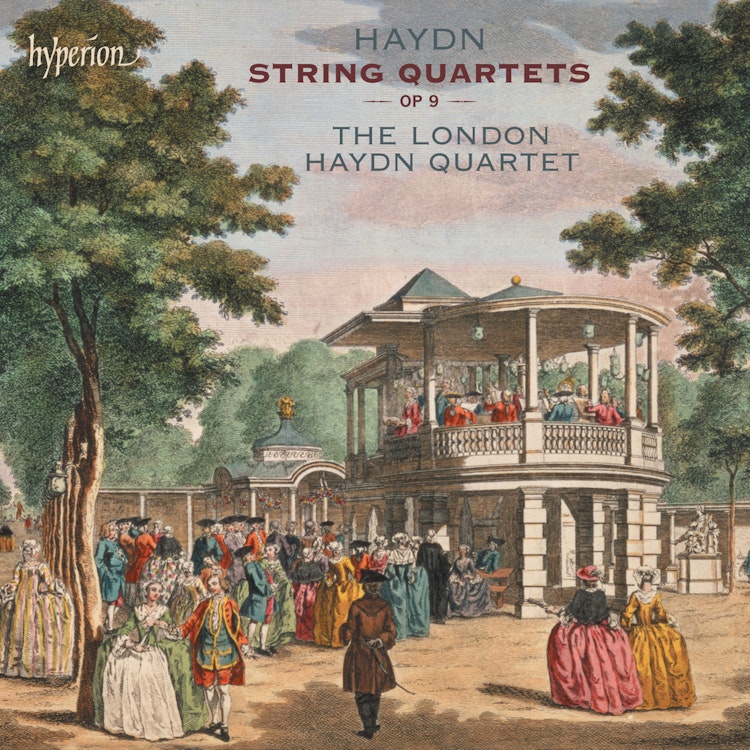
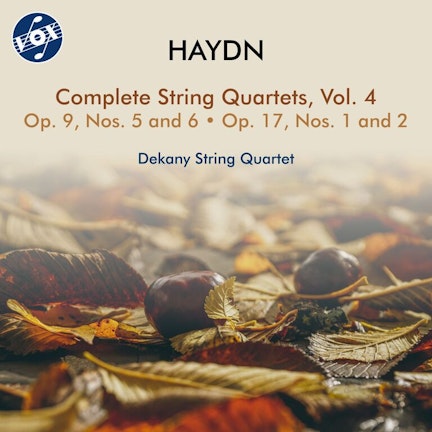
The London Haydn Quartet chose to record the version of the Op. 9 quartets that would have been best known in England, based on a 1790 London edition.
Composer Biography
During the decade before Op. 9, Haydn's work for Prince Nicolaus Esterházy was dominated by symphonies, church music, and pieces for the baryton, a curious viola da gamba with sympathetic strings.
Composition History
Haydn's Op. 9 quartets, along with Op. 17 and Op. 20, were composed in quick succession after a decade-long gap, marking the string quartet's 'coming of age'.
Composer's Artistic Vision
Joseph Haydn, by his own admission, stumbled upon the string quartet form 'by accident' but raised it from humble beginnings to a vehicle for sophisticated musical discourse.
Album & Artwork
The London Haydn Quartet modified the order of the quartets from the 1790 London edition, instead following the order given in Haydn's Entwurf-Katalog, which is arguably the order of composition.
Interpretation
The London Haydn Quartet plays on gut strings with classical bows, and for this recording, they used an 18th-century London edition by Longman and Broderip from 1790.
Compositional Technique
The Op. 9 quartets feature often florid, almost concerto-like first violin parts, likely calculated to showcase the virtuosity of Luigi Tomasini, leader of the Esterházy orchestra.
You might also enjoy...
Haydn: The Seven last Words of Christ
Haydn: String Quartets Op. 33, Nos. 4-6
Haydn: String Quartets, Op. 55 "Tost II" (On Period Instruments)