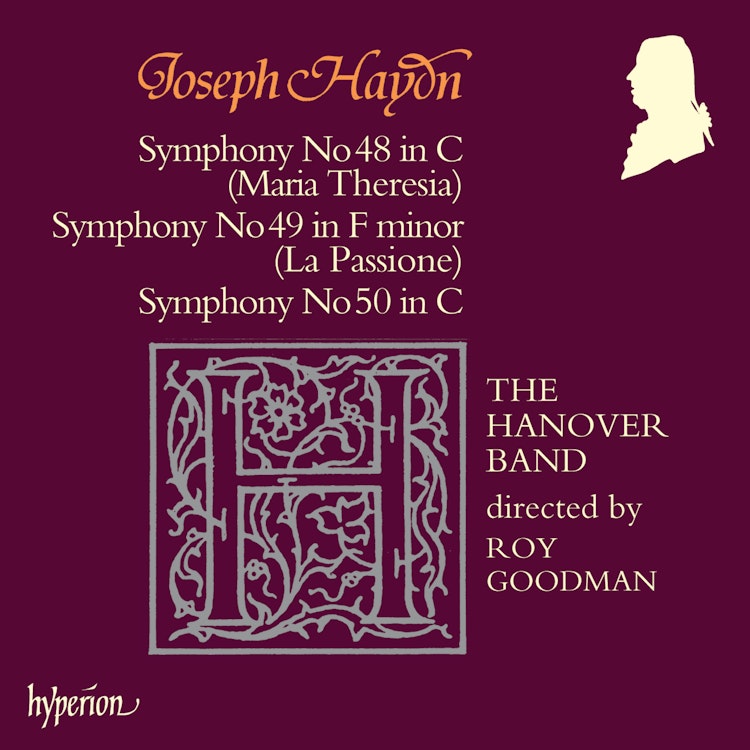
Haydn's Symphony No. 48, 'Maria Theresia,' though written in 1769, was used in 1773 to welcome the widowed Empress Maria Theresia to Eszterháza, giving it its nickname.
Compositional Technique
Symphonies Nos. 48 and 50 are festive works in C major, a key Haydn always reserved for his 'trumpet symphonies,' similar to Bach's use of D major.
Composer Biography
Joseph Haydn spent his early years at the court of Prince Nikolaus Esterházy, where he was appointed in 1761, experimenting and developing his symphonic technique.
Interpretation
Roy Goodman, the conductor, has re-evaluated the tempos of Andante and Minuet movements, which he believes are often performed too slowly today, based on tempo markings by Hummel and Czerny.
Interpretation
The Hanover Band performs on period instruments at a pitch of A = 430Hz, with the conductor Roy Goodman directing from the harpsichord for symphonies 1 to 92.
Composer's Artistic Vision
Haydn's Symphony No. 49, 'La Passione,' is an example of his 'Sturm und Drang' ('storm and stress') works, reflecting an early manifestation of romanticism in European culture.
You might also enjoy...
Haydn: Symphonies Nos. 46, 49 & 82
Haydn: Complete Symphonies, Vol. 3
Haydn: Symphony in G major, Hob. I:100 "Military"; Symphony in B-flat major, Hob. I:102; Symphony in D major, Hob. I:104 "London"
Haydn: Symphonies / Sinfonien Nos. 66, 67, 68
Haydn Symphonien Nr. 45, Nr. 48 & Nr. 49
Haydn: Complete Symphonies, Vol. 3
Haydn: Symphonies Nos. 16-17 & 19-21
Haydn: Symphonies, Vol. 4
Haydn: Symphony in C major, Ho. I:82 "The Bear"; Symphony in G minor, Hob. I:83 "The Hen"; Symphony in E-flat major, Hob. I:84
Haydn: Symphonies 6, 7 & 8 "Le Matin, Le Soir & Le Midi"