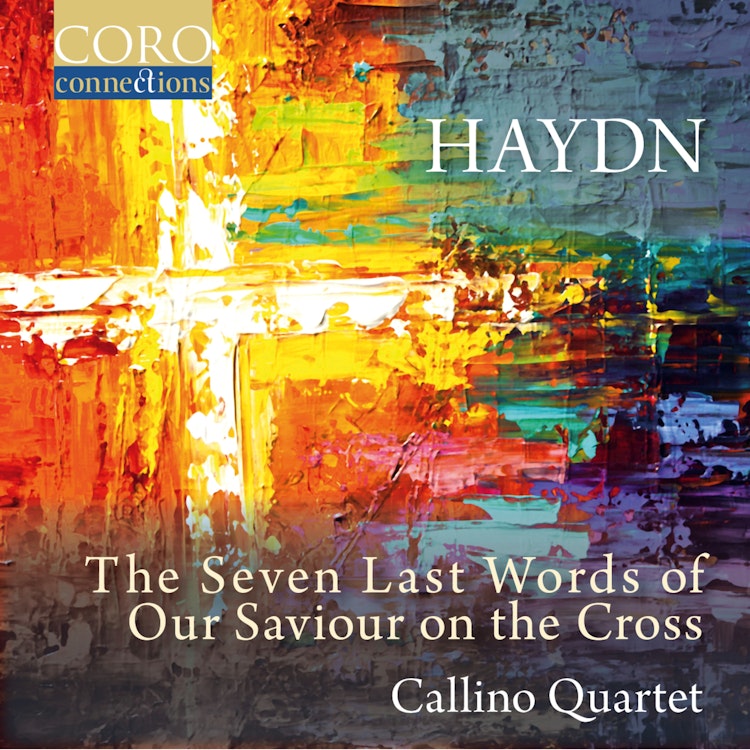
Haydn: The Seven Last Words of Our Saviour on the Cross
3/31/2017, 9 Tracks, 1:07:10
Featuring
Callino Quartet
Joseph Haydn
Did you know?
1/7
Performer Biography
The Callino Quartet, formed in 1999, takes its name from "Cailín cois tSuir a mé," the earliest piece of Irish music notated in the 16th century.
Critical Reception
Haydn's "The Seven Last Words" quickly became one of his most popular works after its 1787 premiere, as admired as any of his symphonies, with publications in Vienna, London, and Paris.
Composer Biography
Haydn considered "The Seven Last Words" one of his most successful creations and reportedly preferred its instrumental version over his later oratorio reworking.
Composition History
Haydn adapted his instrumental "Seven Last Words" into an oratorio after hearing a vocal version by Kapellmeister Joseph Friebert in Passau, with literary assistance from Baron Gottfried van Swieten.
Compositional Technique
Haydn's "The Seven Last Words" is unusual for its form: an introduction followed by seven slow movements, each corresponding to one of Christ's final sentences, concluding with a dramatic earthquake representation.
Composition History
Haydn's "The Seven Last Words of Our Saviour on the Cross" was commissioned by a priest in Cádiz, Spain, for a Lenten Passion oratorio performed in an underground grotto.
Composer's Artistic Vision
Haydn aimed for "The Seven Last Words" to move "even the most uninitiated listener to the depths of his soul," intending it as an encouragement to peaceful contemplation, similar to a church painting or sculpture.
You might also enjoy...
Mozart: String Quartets No. 22 & 23
Haydn: String Quartets Vol. 2
Haydn: Die sieben letzten Worte unseres Erlösers am Kreuze
The Auryn Series, Vol. 30
Haydn: String Quartets Op. 71, Apponyi Quartets
Haydn: String Quartets Vol. 4
Haydn: Prussian Quartets, Op. 50 Nos. 1-3 (On Period Instruments)
Haydn: String Quartets, Op. 9
Haydn: String Quartets Op. 42 and Op. 2, Nos 4 and 6
Haydn: Complete String Quartets, Vol. 1/3
Haydn: String Quartets, Op. 17
Haydn: String Quartets Nos. 23, 24 and 27, 'sun Quartets'