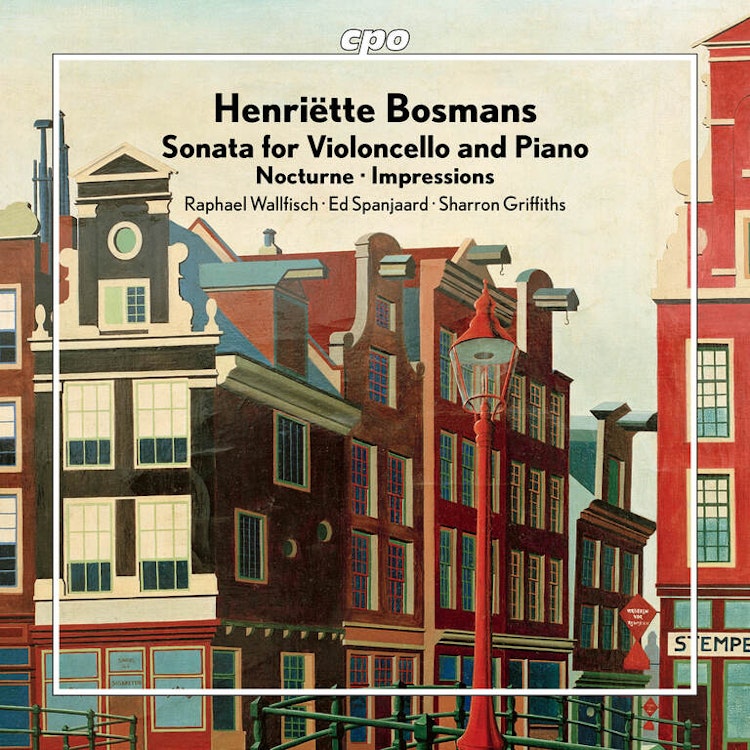
Henriëtte Bosmans: Sonata for Violoncello and Piano - Nocturne - Impressions
7/17/2025, 8 Tracks, 53:57
Featuring
Ed Spanjaard
Raphael Wallfisch
Sharron Griffiths
Henriëtte Bosmans
Did you know?
1/7
Historical Context
Henriëtte Bosmans' compositions were banned from 1942 to May 1945 due to her Jewish heritage on her mother's side during World War II.
Critical Reception
After her death in 1952, Henriëtte Bosmans' generation of composers, including her works for cello and piano, largely fell into obscurity during the 1960s and 1970s, only to be gradually rediscovered in the 1980s.
Performer Biography
Ed Spanjaard, the pianist on this album, is a unique figure in Dutch classical music, working as both a conductor and a pianist, and was invited to perform at the wedding of King Willem-Alexander and Queen Máxima in 2002.
Composer Biography
Henriëtte Bosmans, a Dutch composer, was surrounded by music from birth; her father, Henri Bosmans, was a renowned cellist, and her mother, Sara Benedicts, was an equally talented pianist.
Composition History
The Sonata for Cello and Piano by Henriëtte Bosmans was commissioned by Marix Loevensohn, principal cellist of the Concertgebouw Orchestra, for a chamber music series in Amsterdam.
Performer Biography
Raphael Wallfisch, the cellist on this album, is the President of the British Music Society and a dedicated champion of British repertoire, with many leading British composers writing works specifically for him.
Composer Biography
Henriëtte Bosmans began composing at the age of 15, which she considered relatively late, studying harmony and counterpoint with Jan Willem Kersbergen.
You might also enjoy...
Rozsa: Duo for Cello and Piano / Goldmark: Cello Sonata, Op. 39 / Liszt: Consolations
Approaching Autumn
Voyage
A Deux
Percy Sherwood: Complete Works for Cello and Piano
Keys, Sibelius & Brahms: Works for Cello & Piano
Icicles of Fire
Max Reger: Cello Sonatas and Suites
Our Stories: Contemporary Works by Black and Latinx Composers