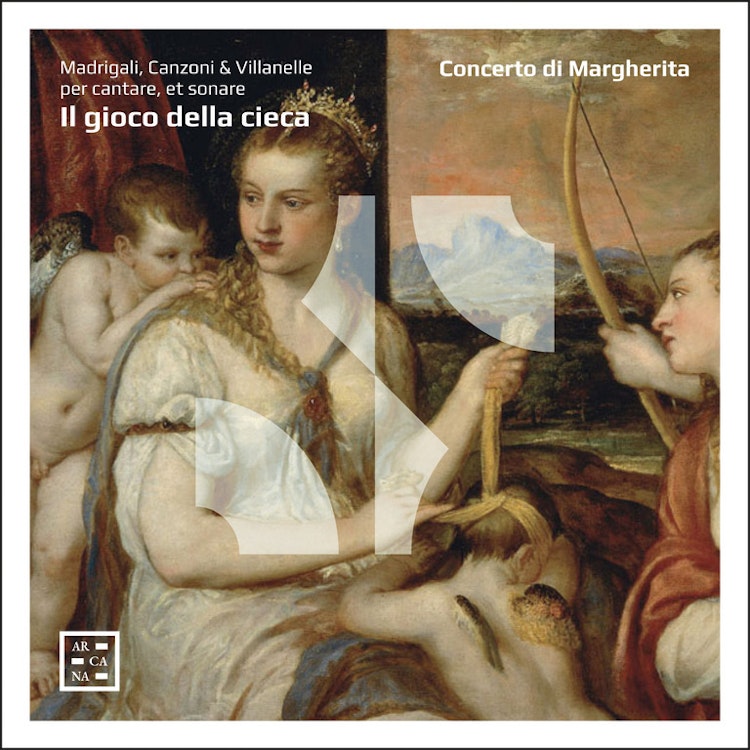
Il gioco della cieca. Madrigali, Canzoni & Villanelle per cantare, et sonare
2/4/2022, 21 Tracks, 45:52
Featuring
Concerto di Margherita
Giovanni Giacomo Gastoldi
Claudio Monteverdi
Giovanni Gabrieli
Giovanni Girolamo Kapsberger
Giaches de Wert
Girolamo Frescobaldi
Sigismondo d'India
Andrea Gabrieli
Did you know?
1/7
Performer Biography
Concerto di Margherita, the ensemble on this recording, is named for Margherita Gonzaga, the last Duchess of Ferrara and patron of the historical Concerto delle dame.
Instruments
The double harp used in this recording was built in 2018 by Simon Capp, modeled after the Este Harp from 1581, which is now housed at the Gallerie Estensi in Modena.
Interpretation
Concerto di Margherita systematically approaches Italian monodic repertoire as an ensemble of self-accompanists, creating a coordinated pursuit of 'affetti' (deep emotional states) that is unprecedented in modern times.
Composer's Artistic Vision
The 'new music' of the early 1600s, as described by the word concerto, combined expressive resources like instruments, voices, solos, and ensembles to elicit deep emotional states (affetti).
Album & Artwork
This recording is named after Act III of Giovan Battista Guarini's 'Il pastor fido', a 'pastoral tragicomedy' that inspired many musical settings of the time.
Historical Context
The term 'concerto' had a longer history, with one of its first associations being with a group of professional singers-instrumentalists, mostly women, known as the Concerto delle dame at Ferrara in the 1570s-1580s.
Compositional Technique
The basso continuo notation, an innovation from the first decade of the 1600s, allowed composers to specify instrumental self-accompaniment and indicate melodic use of instruments alongside voices.
You might also enjoy...
Monteverdi: Combattimento di Tancredi e Clorinda, Lamento della Ninfa ed altri madrigali
Gesualdo: Madrigals, Book 3
Monteverdi: Lamento d'Arianna - Scherzi musicali cioe arie et madrigali
Monteverdi: Madrigali guerrieri ed amorosi (Libro VIII)
Monteverdi, C.: Madrigals, Book 6 (Il Sesto Libro De Madrigali, 1614)
Monteverdi: The Madrigals, Books 3,4,7,8 & 9
Lassus: Le lagrime di San Pietro; Marini: Le lagrime d'Erminia
Les Arts Florissants: Secular Music
Marini: Per le musiche di camera concerti, Op. 7
Monteverdi: Scherzi musicali
Monteverdi: Scherzi musicali
Luzzaschi: Quinto libro de madrigali
Monteverdi: La dolce vita
Monteverdi, C.: Madrigals (Sweet Torment) (I Fagiolini)