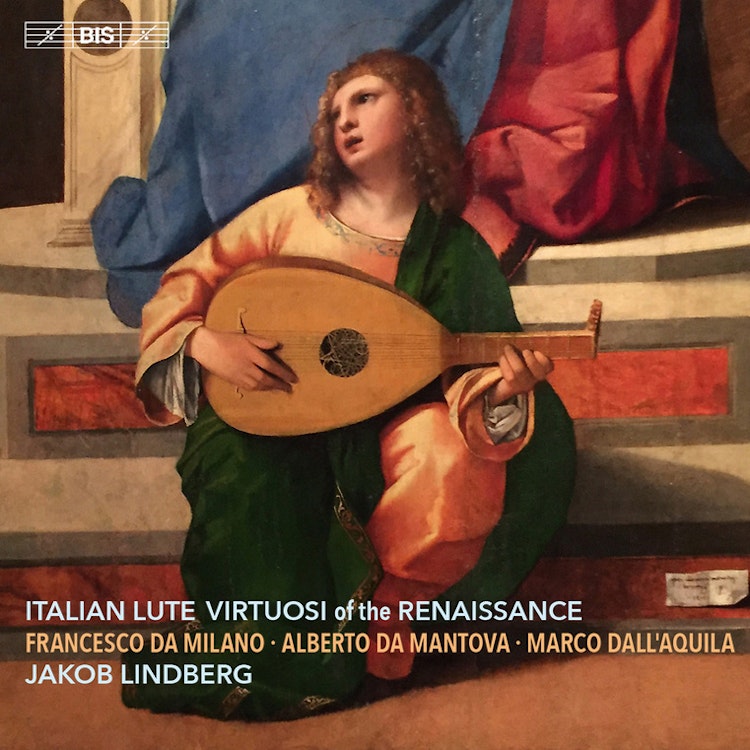
Francesco da Milano, one of the featured lutenists, was known as 'Il Divino' (the Divine One), an epithet he shared with Michelangelo Buonarotti, reflecting his high esteem among contemporaries.
Performer Biography
Jakob Lindberg, the performer on this album, developed his initial passion for music through The Beatles and later became a professor of lute at the Royal College of Music in London.
Compositional Technique
Around the late 1400s, lutenists began plucking strings with fingers instead of a plectrum, allowing them to play multiple musical lines simultaneously and expanding the lute's range to three octaves.
Historical Context
The lute was the most important instrument in Western music for large parts of its 500-year flourishing period, with the sixteenth century being a golden age for the instrument.
Instruments
The recording features a six-course lute by Michael Lowe from 1985, entirely strung in gut, with 'Pistoy' bass strings on courses 4, 5, and 6, each paired with a thinner string tuned at the upper octave.
Compositional Technique
Marco dall'Aquila was an innovator in lute technique, particularly in his use of 'broken style' where chords are broken to create subtle textures and rhythmic interest, a technique that later became known as 'style luthé' in France.
Composer Biography
Alberto da Mantova, a lutenist at the French court, earned an annual salary of 500 livres, twice as much as other court lutenists, and was appointed 'valet de chambre du roi', a title for the best musicians.
You might also enjoy...
Weiss: Selected Works for Lute
Amours amours amours
Scarlatti & Zamboni: 18th Century Italian Lute Music - Toyohiko Satoh 2
HAGEN: Lute Sonatas / Locatelli Variations
The Cozens Lute Book
Lyra Sonora: Music for the 12 Course Lute
Weiss, S.L.: Lute Music, Vol. 2 - Lute Sonatas Nos. 39, 50 / Tombeau Sur La Mort De M. Comte De Logy