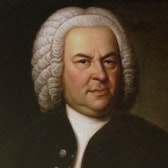
Period ensemble il pomo d’oro and harpsichordist Francesco Corti launch a cycle of J.S. Bach’s brilliant harpsichord concertos, works in which Bach’s typically Germanic flair for counterpoint is married to an Italian-style approach to instrumental writing. This first album in the series contains four concertos that require a fuller orchestral sound.
Featuring
Francesco Corti
Il Pomo d'Oro
Johann Sebastian Bach
Did you know?
1/7
Interpretation
Francesco Corti, the harpsichordist, introduced variations in da capo movements, believing 18th-century performances were subject to the performer's spontaneous inspiration.
Instruments
Francesco Corti plays a 1998 harpsichord by Andrea Restelli, modeled after Christian Vater, while the continuo parts are played on a 2000 Andrea Restelli harpsichord, after Michael Mietke.
Composition History
Bach's harpsichord concertos, including those on this album, are adaptations of earlier string or wind concertos by Bach or other composers.
Interpretation
The performer, Francesco Corti, chose to add a continuo part for a second keyboard instrument to concertos BWV 1053 and 1058, following the model of BWV 1055.
Compositional Technique
Bach's harpsichord concertos are considered the first true harpsichord concertos, profoundly influencing later composers like his sons and Mozart.
Composition History
Bach's harpsichord concertos were compiled into a manuscript collection (BWV 1052-1057) in 1738, during his time directing the Collegium Musicum in Leipzig.
Composer's Artistic Vision
Bach's motivation for creating these keyboard concertos was primarily practical, intended for performances by the Collegium Musicum in Leipzig.
You might also enjoy...
J.S. Bach: Concertos for Harpsichord & Strings, Vol. 2
C.P.E. Bach: Harpsichord Concertos
J. S. Bach: Concerto No. 1 in D minor, BWV 1052 & C.P.E. Bach: Concerto in D minor, Wq. 23