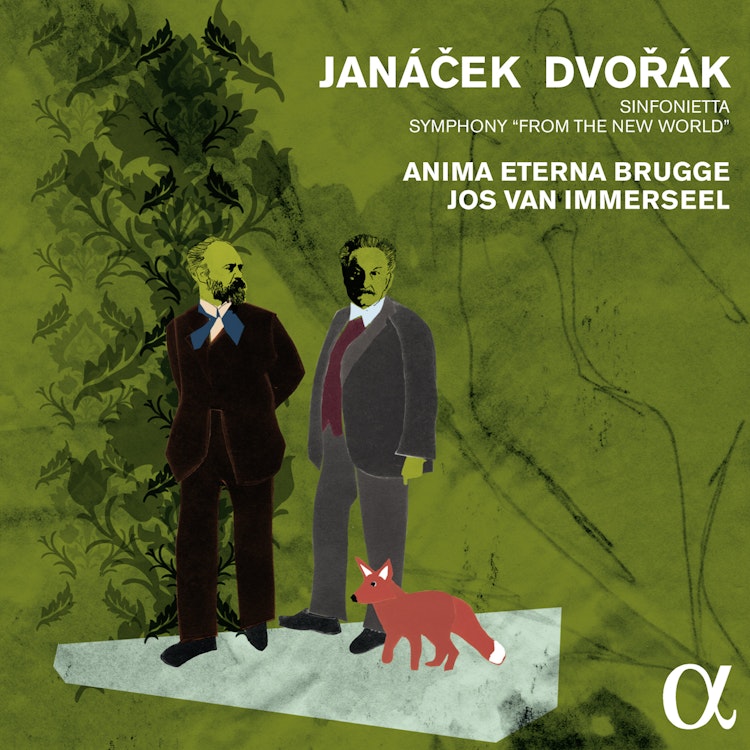
Janáček: Sinfonietta - Dvořák: Symphony "From the New World"
9/4/2015, 10 Tracks, 1:25:44
Featuring
Jos van Immerseel
Fanfare Janáček
Anima Eterna Brugge
Leoš Janáček
Antonín Dvořák
Bedřich Smetana
Did you know?
1/7
Interpretation
Research for this recording revealed that Czech orchestral violinists around 1926 used pure gut E strings and split violin sections, influencing the performance choices for the Sinfonietta.
Interpretation
Anima Eterna Brugge's recording of the Dvořák symphony uses a period orchestral layout with a split bass section, an 18th-century principle, to achieve a more homogeneous sound and improved intonation.
Performer Biography
Anima Eterna Brugge, the orchestra on this recording, was founded by Jos van Immerseel in 1985 with five string players and expanded to seventeen musicians by 1987 to explore Viennese Classical and French Baroque repertoires.
Composer's Artistic Vision
Dvořák, as artistic director of the National Conservatory of Music in New York, aimed to establish an 'American' repertory of art music by studying the national musical heritage.
Compositional Technique
Dvořák's Symphony No. 9 'From the New World' incorporates elements like pentatonic melodies, plagal cadences, ostinato accompaniments, and strong syncopations, drawing from Native American and African-American heritage without direct quotation.
Composition History
Janáček's Sinfonietta was originally conceived as five scenes set in his adopted hometown of Brno, dedicated to the Czech Armed Forces, and composed for the Sokol gymnastic festival after the Czech Declaration of Independence.
Recording & Production
For the Janáček Sinfonietta, the recording features a brass ensemble with period instruments from various geographical origins, including Czech, German, Russian, French, and Viennese brass.
You might also enjoy...
Rachmaninoff: Symphony No. 3, Isle of the Dead & Scherzo for Orchestra