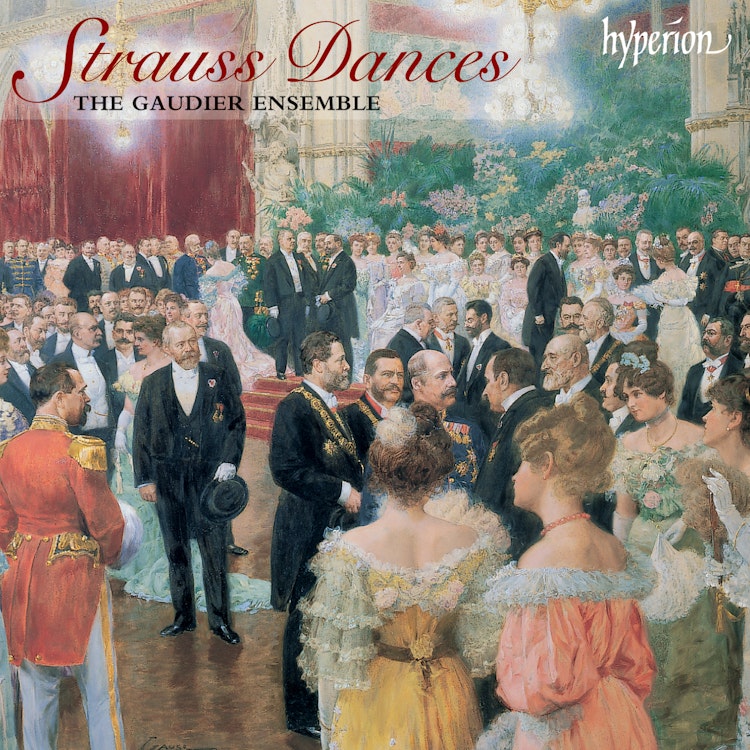
To accommodate smaller ensembles, Johann Strauss I's dances were often published in reduced instrumentation, a practice continued by musicologist Alexander Weinmann, whose arrangements are played on this album.
Compositional Technique
The orchestrations of the Strauss family typically involved basic string harmonisation, with wind and brass instruments adding color.
Composer Biography
Johann Strauss I died at the age of 45 from scarlet fever, contracted from one of his illegitimate children, shortly after returning from a London tour in 1849.
Composer's Artistic Vision
Johann Strauss II's music was known for being more lyrical, relaxed, and refined than his father's, lacking the elder Strauss's 'unquenched restlessness'.
Performer Biography
The Gaudier Ensemble, named after French sculptor Henri Gaudier-Brzeska, is a group of European musicians who perform chamber music for wind and strings, with members from major orchestras.
Composer Biography
The Strauss family, including Johann Strauss I (the founder) and his three sons Johann II, Josef, and Eduard, were unrivaled as dance-musicians, with their music spreading globally through their tours.
Historical Context
In 19th-century Vienna, dance halls were prominent public meeting places, with waltz, polka, and galop being the most popular dance styles.
You might also enjoy...
Neujahr in Wien
Mozart: German Dances
Strauss I, J.: Edition - Vol. 6
Strauss I, J.: Edition - Vol. 6
Bartók : Divertimento, Romanian Folk Dances & Kodály : Marosszék & Galánta Dances