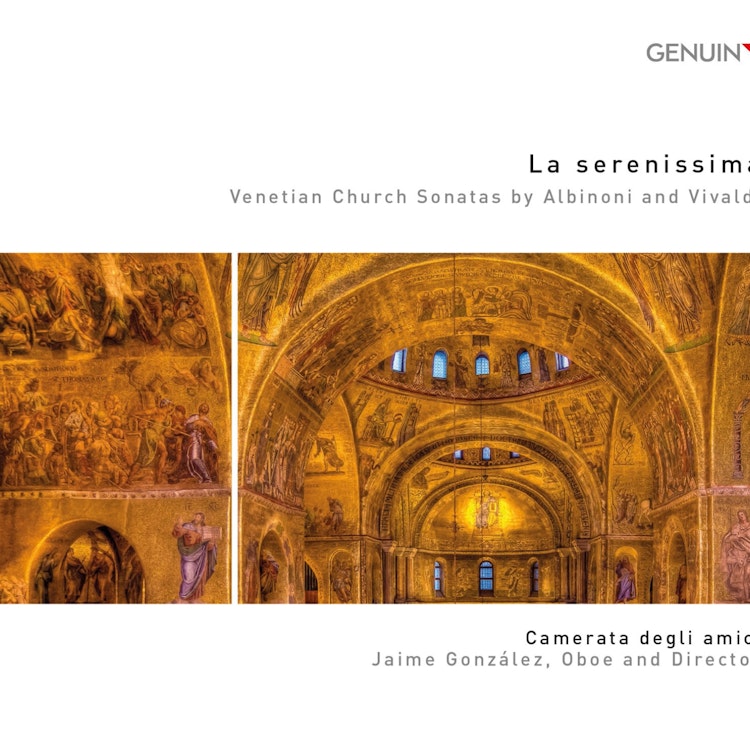
The album title "La Serenissima" refers to Venice, which was known as "La Serenissima" (the Most Serene Republic) in the 17th and 18th centuries.
Composition History
The trio sonata was highly regarded in the late 17th and early 18th centuries, similar to the classical string quartet, and many composers, including Albinoni and Vivaldi, published their first works as sets of trio sonatas.
Recording & Production
The continuo group in this recording uses a harpsichord, lute, cello, and bassoon, allowing for diverse musical affects and tonal structures across the sonata movements.
Compositional Technique
Baroque trio sonatas, like those by Albinoni and Vivaldi, typically feature two higher parts and a basso continuo group, with flexibility in instrumentation, often replacing violins with wind instruments like oboes.
Composer Biography
Tomaso Albinoni, a composer from a wealthy Venetian family, was considered a 'dilettante' – a term that in his time meant someone who could compose and play at a high level without needing to earn a living as a professional musician.
Interpretation
This recording replaces the original two violins in Tomaso Albinoni's Trio Sonatas, Op. 1, with two oboes, in keeping with the historical Baroque practice of flexible instrumentation.
Historical Context
Venice was a leading European music center, famous not only for opera but also for sacred music and instrumental music like the solo concerto, concerto grosso, and trio sonata.
You might also enjoy...
Fasch: Overtures and Concerto in D Major & Sonatas for Oboes and Bassoon
L'Occhio del Cor
Johann Friedrich Fasch: Chamber Music with Oboe (Glaetzner)
Canadian Hits: Unplugged
Tom Flaherty: Mixed Messages
Marcello: Flute Sonatas Vol. 1
Isabel I, Reina De Castilla
Paul Juon: Chamber Music for Viola
Bach's Roots. Early Influences on the Young Master
Francaix, J.: Musique Pour Faire Plaisir / Bozza, E.: Octanphonie / Lavista, M.: Octeto / Toussaint, E.: Oktkt