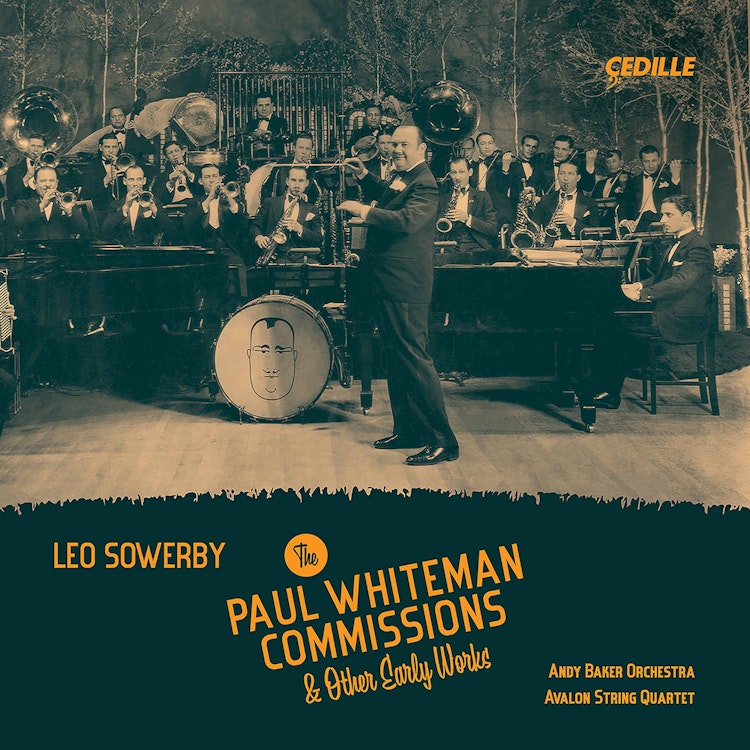
Leo Sowerby: The Paul Whiteman Commissions & Other Early Works
8/13/2021, 10 Tracks, 1:19:06
Featuring
Andrew Baker
Blaise Magnière
Marie Wang
Anthony Devroye
Cheng-Hou Lee
Winston Choi
Alexander Hanna
Andy Baker Orchestra
Avalon String Quartet
Leo Sowerby
Did you know?
1/7
Composer Biography
Leo Sowerby, the composer, was recognized as a musical prodigy by age ten and went on to compose 550 works in all forms except opera.
Composition History
The Symphony for Jazz Orchestra, originally titled 'Monotony,' was conceived as a stage work with a 6'5" metronome as its centerpiece and a literary subtext based on Sinclair Lewis's novel 'Babbitt.'
Recording & Production
The String Quartet in D minor was recorded from an engraved score made from a pencil copy, lacking dynamics, accents, or bowings, requiring the Avalon String Quartet to act as co-creators.
Recording & Production
The scores for Synconata and the Symphony for Jazz Orchestra ('Monotony') were challenging to perform because they were written for specific musicians in Paul Whiteman's orchestra, not standard instrumentation, and required re-scoring for this recording.
Composition History
The two jazz works, Synconata and Symphony for Jazz Orchestra ('Monotony'), were commissioned by Paul Whiteman, a society band leader who aimed to give American composers opportunities to be heard.
Recording & Production
Four of the works on this album — Synconata, the Symphony for Jazz Orchestra ('Monotony'), String Quartet in D minor, and Tramping Tune — are world premiere recordings.
Composer's Artistic Vision
Leo Sowerby's String Quartet in D minor incorporates jazz elements, with its first movement described by the composer as a "glorified fox-trot, with plenty of blues thrown in."
You might also enjoy...
Krása, Tansman & Krenek: Works for String Quartet
Ginastera: String Quartets
Korngold: String Quartets Nos. 1-3 / Piano Quintet, Op. 15
Guridi: Cuartetos para cuerda
Nielsen: String Quartets 2 & 3
Weigl: String Quartets Nos. 7 & 8
Whittington: Music for Airport Furniture
Richard Wilson & Steven Mackey: String Quartets
Martinů, B.: String Quartets Nos. 4, 5 and 7
Zemlinsky, A.: String Quartets Nos. 1 and 2
Howard Hanson: String Quartet / Randall Thompson: String Quartets 1 and 2