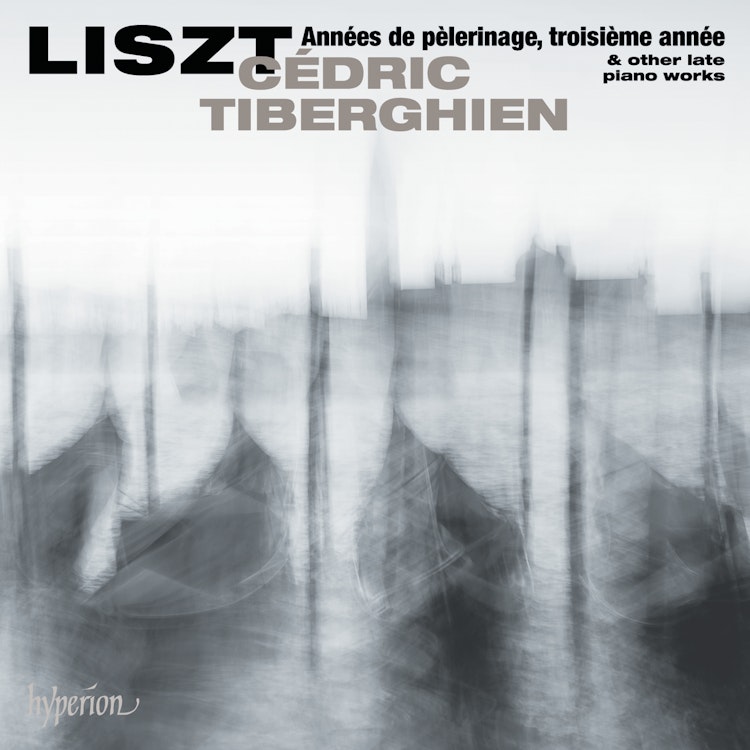
Liszt: Années de pèlerinage, 3ème année & Other Late Piano Works
2/16/2024, 13 Tracks, 1:20:11
Featuring
Cédric Tiberghien
Franz Liszt
Did you know?
1/7
Composition History
Liszt's La lugubre gondola II was inspired by silent funeral processions in Venice and written shortly after he had a premonition of his son-in-law Richard Wagner's death.
Composer Biography
Liszt dedicated his Wiegenlied ('Cradle song') to his pupil Arthur Friedheim, who would become his amanuensis, or literary assistant, the following year.
Composer's Artistic Vision
According to British pianist John Ogdon, Liszt was responsible for breaking the German dominance over 19th-century composers and scattering the seeds of modern music.
Composer Biography
The pieces in the Années de pèlerinage, troisième année were composed after Liszt received the tonsure and minor orders of the Catholic Church, beginning his life as 'the Abbé Liszt'.
Compositional Technique
In Les jeux d'eaux à la Villa d'Este, Liszt quotes a passage from the Gospel According to St John about 'living water', foreshadowing 20th-century 'water pieces' by composers like Ravel.
Historical Context
Liszt's Marche funèbre commemorates the execution of Emperor Maximilian I of Mexico, a Habsburg and younger brother of Austrian Emperor Franz Joseph I, in 1867.
Compositional Technique
Liszt's Bagatelle sans tonalité, originally titled Mephisto Waltz No. 4, concludes with an unsettling upward rush of twenty-five diminished seventh chords that do not resolve the tonality.
You might also enjoy...
Tristan
Lekeu: Complete Piano Works
Liszt: Between Light & Darkness
Piano Recital: Ashley Wass
Piano Recital: Ashley Wass
Liszt: Reminiscences Des Puritains De Bellini and Other Rare Piano Works
Liszt & Wagner: Piano Works
Liszt: Piano Music
Metanoia
Liszt: Piano Music
20th Century Classics - Leos Janácek
Janácek: The Diary of One Who Disappeared & Songs
Complete Piano Music, Vol. 56: Liszt – Préludes et harmonies poétiques et religieuses