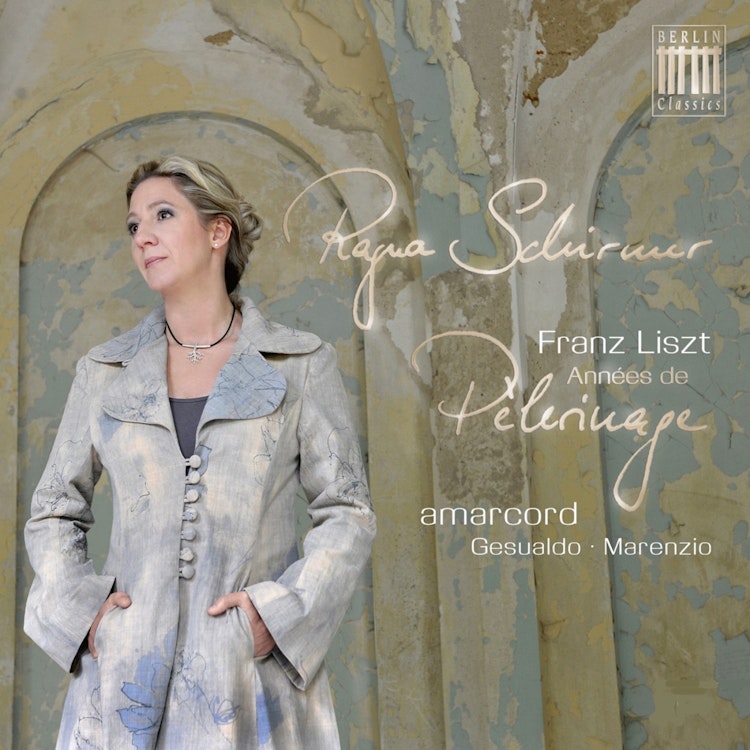
Liszt: Années de pèlerinage, S. 160-163 - Gesualdo & Marenzio: Madrigals
10/14/2011, 34 Tracks, 3:21:48
Featuring
Ragna Schirmer
Amarcord
Franz Liszt
Carlo Gesualdo
Luca Marenzio
Did you know?
1/7
Cultural Impact
Lord Byron's verse epic "Childe Harold's Pilgrimage," which inspired some of Liszt's works on this album, made its author famous and introduced the 'Byronic hero' archetype.
Historical Context
The madrigal, a polyphonic setting of secular verse, was a crucial musical form of the Renaissance and early Baroque, emerging around 1520 in Florence and Rome.
Composer Biography
Franz Liszt and Marie d'Agoult, his mistress and mother of his three children, lived in Geneva in 1835, where Liszt earned a living teaching and composing.
Cultural Impact
Homesickness, or "mal du pays," was defined in 1688 by physician Johannes Hofer; homesick Swiss mercenaries were forbidden to sing their traditional herdsman's songs, the Ranz des Vaches.
Composition History
Franz Liszt's "Années de Pèlerinage" (Years of Pilgrimage) were published between 1855 and 1883 and draw on various sources, including literary works and artists.
Composer Biography
Carlo Gesualdo (1566-1613), a Prince of Venosa and accomplished composer, had his wife and her lover killed in 1590, along with a possibly illegitimate daughter.
Historical Context
The d'Este family, important Renaissance patrons of the arts, influenced composers like Luca Marenzio and Carlo Gesualdo through their vocal ensemble, Concerto delle Donne.
You might also enjoy...
Liszt: Années de pèlerinage, S. 160-163 - Gesualdo & Marenzio: Madrigals
Strana armonia d'amore
Si breve è 'l tempo. Madrigals in the Low Countries
Gesualdo: Prince of Madrigalists
The Magic of Polyphony
Gesualdo: Madrigals
Madrigals & Sacred Songs
A 14th-Century Salmagundi
De Rore: Missa Praeter rerum seriem
Her Heavenly Harmony: Profane Music From the Royal Court
Eros und Gewalt
Queen of Hearts: Laments and Songs of Regret for Queens Terrestrial and Celestial