Franz Liszt, the composer, had a strong inclination towards the Roman Catholic Church and was often present among the Roman curia.
Interpretation
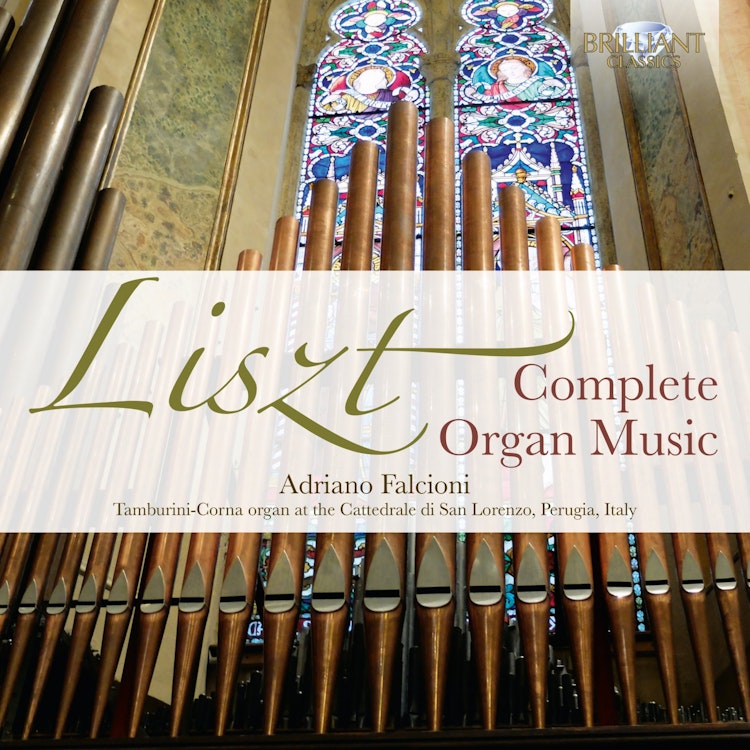
Adriano Falcioni's interpretation of Liszt's organ works treats the instrument in a distinctly orchestral fashion, aiming to reproduce two concomitant orchestras interacting in dialogue.
Composition History
Liszt's organ music began to play a role in his life in 1836 during a journey through Switzerland, where he famously improvised for four hours on an organ in Fribourg.
Performer Biography
Adriano Falcioni, the organist on this recording, is the principal organist of San Lorenzo Cathedral in Perugia, Italy, and founder of an international summer festival there.
Instruments
The recording features the Tamburini-Corna organ at the Cattedrale di San Lorenzo in Perugia, Italy, which has four manuals, 87 stops, and 5178 pipes.
Compositional Technique
Liszt approached the organ as a 'gigantic amplified piano,' aiming to expand its acoustic effects and redefine sound through stop combinations, like a 'Berlioz orchestra in console form.'
You might also enjoy...
Saint-Saëns: Organ Works, Vol. 4
John Gardner: Complete Organ Music, Vol. 1
Vierne: Complete Organ Works Vol. 3
Franck: Complete Organ & Harmonium Works
Yon: Complete Organ Music, Vol. 1
Quinney, Robert: Organ of Westminster Cathedral (The)