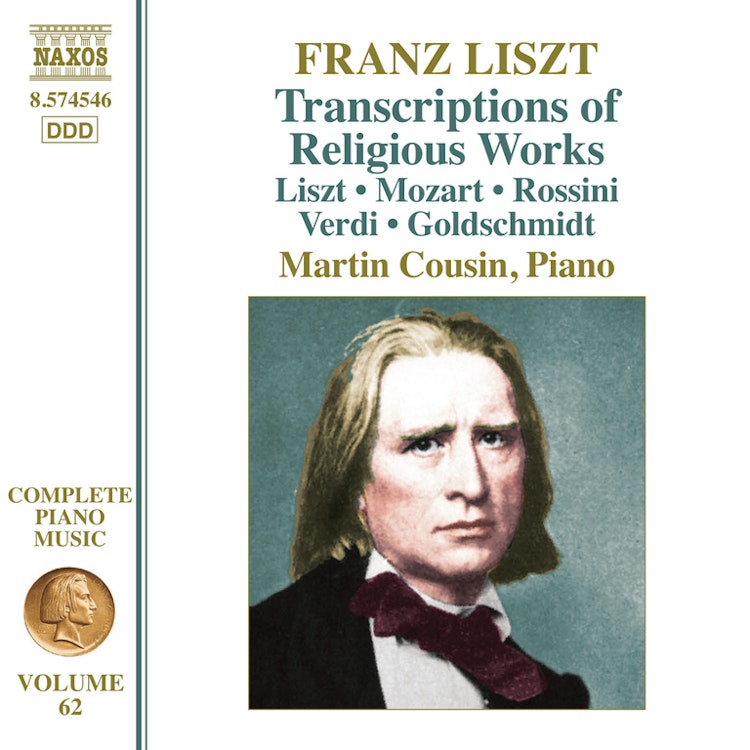
Liszt: Complete Piano Music, Vol. 62: Transcriptions of Religious Works
5/24/2024, 11 Tracks, 1:16:19
Featuring
Martin Cousin
Franz Liszt
Did you know?
1/6
Compositional Technique
Liszt's "À la Chapelle Sixtine" combines and reworks two distinct religious pieces: Gregorio Allegri's "Miserere mei, Deus" and Mozart's "Ave verum corpus."
Performer Biography
Martin Cousin, the pianist on this album, won First Prize at the 2005 Ettore Pozzoli International Piano Competition and the Gold Medal at the 2003 Royal Over-Seas League Annual Music Competition.
Composer Biography
Franz Liszt, a Hungarian composer and virtuoso pianist, joined the Third Order of St Francis in 1857 and became an Abbé eight years later, reflecting the spiritual and mystical aspects of his life.
Composer Biography
Adalbert von Goldschmidt, a Jewish-Viennese composer, poet, and satirist, was a disciple of Liszt and Wagner, and a friend of Hugo Wolf and Bruckner.
Composer's Artistic Vision
Liszt believed the piano was a "microcosm of music," allowing him to transcribe and transform works across various genres and historical periods.
Composition History
Liszt's oratorio Christus, written between the late 1840s and late 1870s, was considered by him to be his "musical Will and Testament."
You might also enjoy...
MozartReworked
Nacht und Träume
Illegal Harmonies
Barry Douglas Plays Liszt & Berg & Webern
Liszt: Complete Piano Music 11 – The Late Pieces
Vida breve: Bach, Busoni, Chopin, Liszt, Hough, Gounod
McCabe: Farewell Recital
Tomoharu Ushida Best
Piano Recital: Rangell, Andres - Scarlatti, D. / Brahms, J. / Ravel, M. / Schubert, F. / Bach, J.S. (A Recital of Intimate Works, Vol. 2)