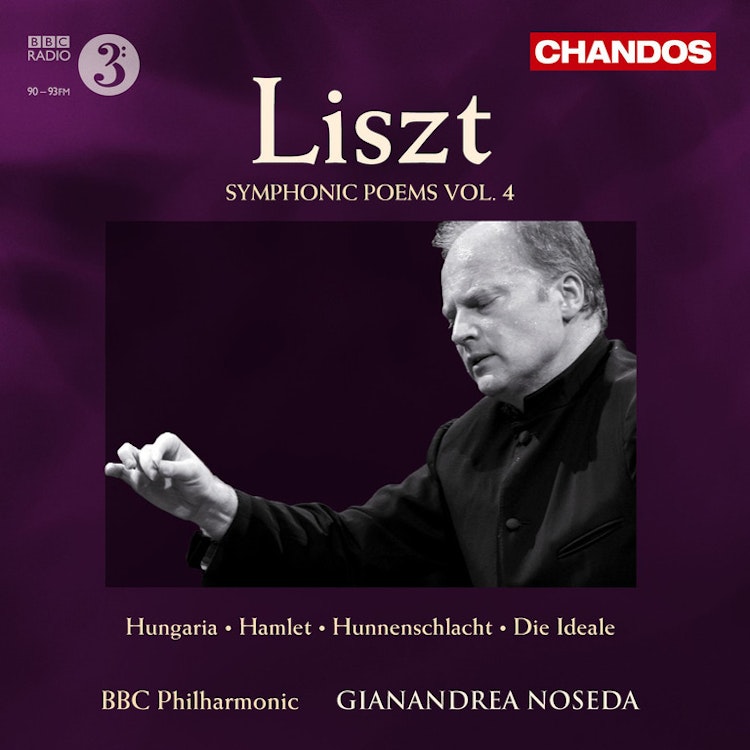
Liszt, F.: Symphonic Poems, Vol. 4 - Hungaria / Hamlet / Hunnenschlacht / Die Ideale
11/18/2010, 4 Tracks, 1:19:51
Featuring
Gianandrea Noseda
BBC Philharmonic
Franz Liszt
Did you know?
1/7
Recording & Production
This Chandos recording uses 24-bit technology, which offers a dynamic range up to 48 dB greater and 256 times the resolution of standard 16-bit recordings.
Composer's Artistic Vision
Unlike Hector Berlioz, who used narrative techniques in his program music, Liszt aimed to represent an overall mood or character rather than specific details in his symphonic poems.
Composition History
Franz Liszt coined the term "symphonic poem" around 1853 to describe orchestral works inspired by other art forms, history, or legend.
Compositional Technique
Peter Raabe's research proved that the final versions of Liszt's symphonic poem scores are entirely his own, despite earlier beliefs that assistants had fully orchestrated them.
Composer's Artistic Vision
Liszt believed that much of the essential impact of his symphonic poems could not be written down and relied on the sympathetic and spirited reproduction by the conductor and performers.
Compositional Technique
In his symphonic poems, Liszt pushed the boundaries of orchestration, form, harmony, and structure, often employing metamorphoses of themes.
Composer Biography
When Liszt began writing his symphonic poems, he lacked confidence in his orchestration skills and initially sought help from August Conradi and Joachim Raff.