Franz Liszt aimed for a 'rejuvenation of music by its more profound link with the art of poetry,' which he achieved through his symphonic poems.
Cultural Impact
The term 'Lisztomania' was used around 1840 to describe the feverish excitement Franz Liszt, the greatest pianist of the 19th century, caused in Europe's musical centers.
Performer Biography
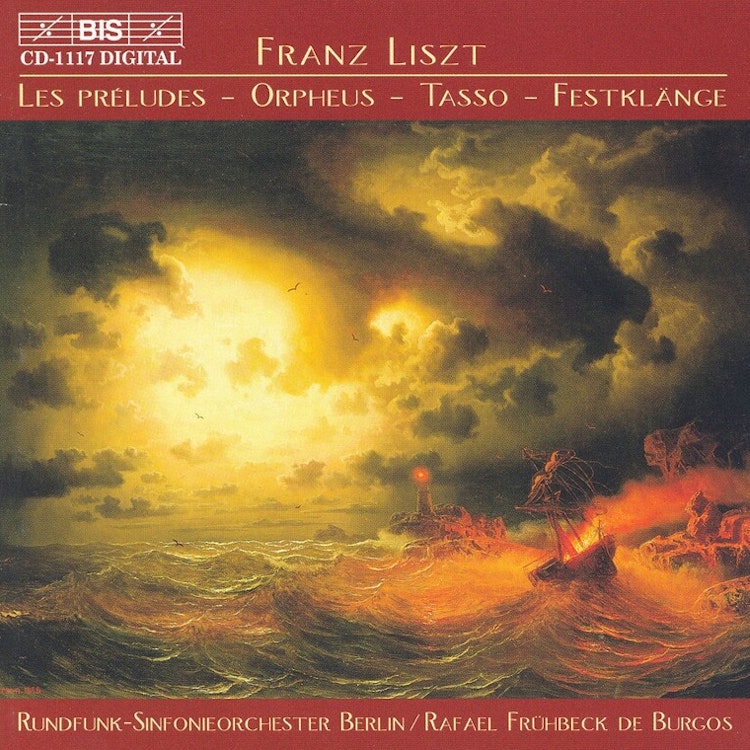
Rafael Frühbeck de Burgos, the conductor on this album, served as the principal conductor of the Berlin Radio Symphony Orchestra from 1994 until 2000.
Compositional Technique
Franz Liszt's single-movement symphonic poems are typically constructed from a single main theme, whose evolving history forms the basis of the musical narrative.
Composition History
In 1847, at the height of his fame, Franz Liszt ended his career as a pianist to focus on composition, leading to his 'invention' of the symphonic poem.
Performer Biography
The Berlin Radio Symphony Orchestra was founded in 1923 as Germany's first dedicated radio symphony orchestra and has a special interest in contemporary music.
Composer Biography
Franz Liszt, born in Hungary in 1811, was considered the greatest pianist of the 19th century, earning nicknames like 'the Paganini of the piano'.
You might also enjoy...
Weiner: Toldi, Op. 43
Liszt: Héroïde funèbre, symphonic poem No. 8
Liszt: Symphonic Poems, Vol. 1
Liszt, F.: Symphonic Poems, Vol. 4 - Hungaria / Hamlet / Hunnenschlacht / Die Ideale
Liszt: Symphonic Poems
Liszt: Les Préludes - Tasso - Orpheus
Liszt: Die Ideale, Symphonic Poem
Liszt: Symphonic Poems, Vol. 3
Liszt, F.: Symphonic Poems, Vol. 1 - Ce Qu'On Entend Sur La Montagne / Tasso: Lamento E Trionfo / Les Preludes / Orpheus
Liszt: Les Préludes
LISZT, F.: Les Preludes / Tasso / Prometheus (Neumann, Plasson)