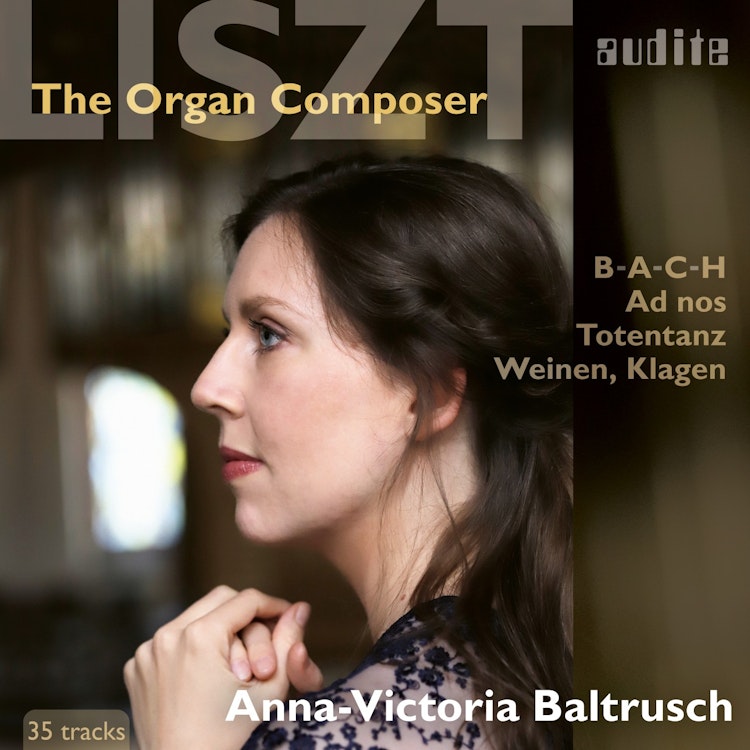
Franz Liszt, though not an organist, regularly performed on the organ even during his years as a traveling piano virtuoso.
Composer's Artistic Vision
Liszt believed the organ, with its rich colors and polyphonic capabilities, served as a link between the piano and the orchestra.
Performer Biography
Anna-Victoria Baltrusch, the concert organist on this album, has won numerous international organ competitions, including the International Organ Competition of the Bach Society Wiesbaden in 2009.
Composition History
Liszt's 'Weinen, Klagen, Sorgen, Zagen' was composed during a period of personal calamities, including the rejection of his marriage plans and the deaths of his two children.
Interpretation
Anna-Victoria Baltrusch, the performer, incorporates more complex bass lines from Liszt's piano versions into her organ pedal passages for the Fantasia and Fugue on 'Ad nos, ad salutarem undam'.
Compositional Technique
The Fantasia and Fugue on 'Ad nos, ad salutarem undam' combines elements of sonata form, variation cycle, multi-movement rolled into one, and the Baroque pairing of fantasia and fugue.
Composition History
Liszt's Fantasia and Fugue on the chorale 'Ad nos, ad salutarem undam' was inspired by a theme from Giacomo Meyerbeer's opera 'Le prophète', which Liszt saw premiered in Paris in 1849.
You might also enjoy...
Finlandia (Organ Imageries)
Robert Schumann: Organ Works Nos. 56, 58 & 60
César Franck: 12 pièces pour grand orgue
Howells, Herbert: Organ Sonata / Partita / Rhapsody No. 2 / Intrata
Jeanne Demessieux - The Decca Legacy
Franck: Grandes œuvres pour orgue (À l'orgue de l'église Saint-Étienne de Caen)
B.A.C.H
Symphonic Organ Music, Vol. 1
The Lincoln Legend, Vol. 11 (Live)
Saint-Saëns: Organ Music, Vol. 1 – La Madeleine, Paris
L'amour et la mort: Organ Works by Widor, Saint-Saens, Bizet & Faure