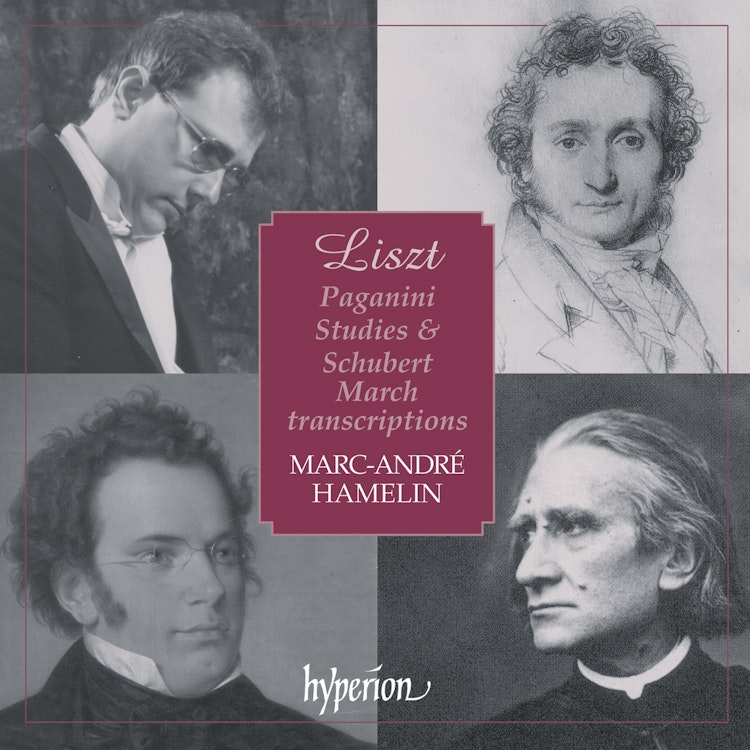
Liszt: The Paganini Studies & The Schubert Marches
10/27/2023, 9 Tracks, 57:49
Featuring
Marc-André Hamelin
Franz Liszt
Did you know?
1/7
Critical Reception
Robert Schumann, a composer who also transcribed Paganini's Caprices for piano, praised Liszt's superior accomplishment, calling his collection 'probably the most difficult ever written for the pianoforte'.
Performer Biography
Marc-André Hamelin, the pianist on this recording, is known for his original blend of musicianship and virtuosity, and has been called 'a true avatar of the piano'.
Composer's Artistic Vision
After hearing Paganini, Liszt resolved to transform himself into the pianistic equivalent of the 'demonic Italian' violinist.
Composer Biography
Franz Liszt, the composer of the Paganini Studies and Schubert March transcriptions, was deeply affected by seeing the legendary Italian virtuoso violinist Paganini perform in Paris in 1832.
Composition History
The Six Grandes Etudes de Paganini by Liszt were first published in 1838 as Six études d'exécution transcendante d'après Paganini, then revised and reissued in 1851.
Compositional Technique
Liszt's Paganini Studies are based on Paganini's Twenty-four Caprices Op. 1 for solo violin, with the exception of No. 3 ('La Campanella'), which uses a theme from Paganini's Second Violin Concerto.
Composer Biography
Liszt's transcriptions of Schubert's Marches coincided with a shift in his career from traveling virtuoso to focusing on composition and teaching.
You might also enjoy...
Transcendental - Daniil Trifonov Plays Franz Liszt (Etudes S. 139, S. 141, S. 144, S. 145)
Babadjanian: Complete Works for Piano Solo
Liszt, F.: 6 Etudes D'Execution Transcendante D'Apres Paganini / Schubert - Mullerlieder / Verdi - Rigoletto: Paraphrase De Concert