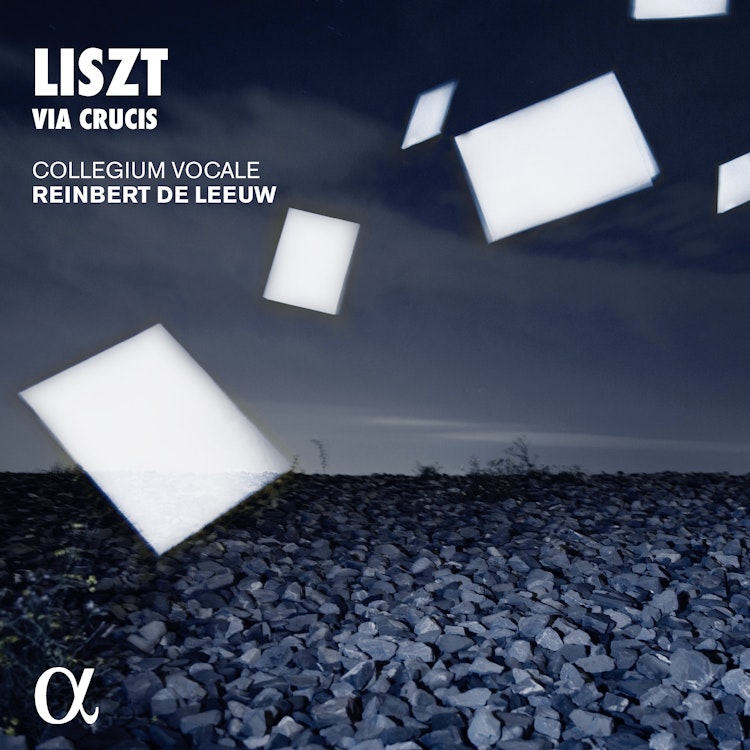
Liszt composed "Via Crucis" in Rome in 1878 while at the Villa d'Este, during a period of deep depression and loss of old friends.
Compositional Technique
For "Via Crucis," Liszt deliberately rejected orchestral colors, opting for a simple keyboard instrument (organ, harmonium, or piano) to accompany the choir, emphasizing economy and asceticism.
Compositional Technique
Liszt's "Via Crucis" explores atonality and uses unprecedentedly audacious modulations, pushing harmonic boundaries, especially for sacred music.
Notable Performances
Liszt's "Via Crucis" had its first performance fifty years after its composition, in Budapest on Good Friday 1929.
Composer Biography
Franz Liszt, after a period as a 'superstar' pianist, turned to a more spiritual life, receiving minor holy orders in 1865 and living the last twenty years of his life as an 'Abbé'.
Performer Biography
Reinbert de Leeuw, the conductor and pianist on this album, is a world-renowned musician in modern and contemporary music, having won numerous awards for his recordings.
Composer's Artistic Vision
In his later years, Liszt sought a radically new musical expression, free from earlier 'flashy trappings', aiming for profundity of soul and heart rather than immediate sensuality.
You might also enjoy...
Mendelssohn: Sacred Choral Works
Rheinberger, J.G.: Mass in E-Flat Major / Wie Lieblich Sind Deine Wohnungen / Stabat Mater / 5 Hymnen / Abendlied
Josef Gabriel Rheinberger: Cantus Missae. Musica sacra II
Brahms: Rhapsody for Alto - Mendelssohn: Motets
Tchaikovsky: Liturgy of St John Chrysostom, Op. 41; 9 Sacred Choruses
Mendelssohn, Felix: Church Music, Vol. 5 - Denn Er Hat Seinen Engeln Befohlen Uber Dir / Die Deutsche Liturgie
Mendelssohn: Denn er hat seinen Engeln befohlen. Kirchenwerke V
Mendelssohn, Felix: Church Music, Vol. 3 - 3 Psalms / Christus / Kyrie in D Minor / Jube Domine / Jesus, Meine Zuversicht
Mendelssohn: Te Deum à 8, MWV B 15 & Other Works
Mendelssohn: Symphony No. 2, Op. 52, "Lobgesang"
Mendelssohn: Herr Gott, dich loben wir. Kirchenwerke IX
Mendelssohn, Felix: Church Music, Vol. 9 - Herr Gott, Dich Loben Wir / Kommt, Lasst Uns Anbeten