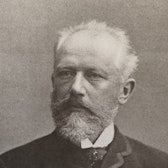
Tchaikovsky: Liturgy of St John Chrysostom, Op. 41; 9 Sacred Choruses
9/29/2023, 20 Tracks, 1:14:54
Featuring
Matthew Best
Corydon Singers
Pyotr Ilyich Tchaikovsky
Did you know?
1/7
Notable Performances
Despite the legal dispute, Tchaikovsky's Liturgy was first performed in June 1879 at the university church in Kiev, and later enthusiastically received in a concert version in Moscow in December 1880.
Composition History
Tsar Aleksandr III (1881-1894) encouraged Tchaikovsky to write more sacred music, leading the composer to create three additional settings of the Cherubic Hymn between 1884 and 1885.
Composition History
The publication of Tchaikovsky's Liturgy in 1879 led to a lawsuit against his publisher, Pyotr Jurgenson, because the Imperial Chapel's authorization was not obtained.
Composer's Artistic Vision
Tchaikovsky, though not a regular churchgoer, felt a deep emotional connection to the rituals and music of the Orthodox Church, which influenced his liturgical compositions.
Composition History
The Easter zadostoynik, Angel vopiyashe, was written in 1887 for the Moscow Choral Society's inaugural concert, but was lost and only published in 1906, thirteen years after Tchaikovsky's death.
Compositional Technique
In some sections, like the Creed and the Lord's Prayer, Tchaikovsky uses a rapid choral recitative, a technique typical of the Russian tradition.
Compositional Technique
Tchaikovsky's setting of the Liturgy of St John Chrysostom, while sometimes considered 'Western', is characterized by simplicity and transparency in its choral writing, prioritizing the text.
You might also enjoy...
Stravinsky: Mass & Symphony of Psalms
Bach 333: 4-Parts Chorales
Steinberg: Passion Week
Chesnokov: Sacred Choral Music
Stravinsky: Sacred Choral Works
Peter Cornelius: Seele, vergiss sie nicht
Cornelius, P.: Choral Music
Langgaard, R.: Choral Music (Rose Garden Songs)
Lewkovitch: Apollo's Art
Tchaikovsky: Liturgy of St. John Chrysostom, Op. 41, TH 75 (Excerpts) & 9 Sacred Pieces, TH 78