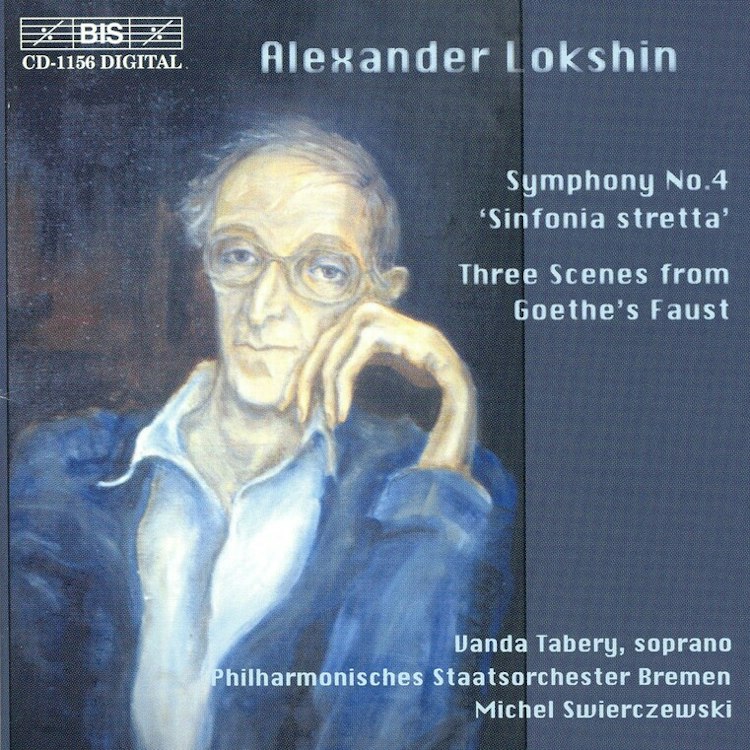
Lokshin: Symphony No. 4, "Sinfonia Stretta" / Three Scenes From Goethe's Faust
9/30/2002, 18 Tracks, 55:15
Featuring
Michel Swierczewski
Vanda Tabery
Bremer Philharmoniker
Alexander Lokshin
Did you know?
1/7
Performer Biography
Vanda Tabery, the soprano on this recording, won first prize at the Prague Music Academy singing competition and the Antonín Dvořák International Singing Competition, also receiving a Special Prize for Contemporary Music Performance.
Compositional Technique
A typical feature of Lokshin's work is the free use of variation form, where different appearances of a theme function as metamorphoses of a 'germ cell', reflecting his idea of music as an organically growing organism.
Composer Biography
Lokshin was expelled from the Moscow Conservatory in 1941 after his diploma piece, Three Pieces after 'Les Fleurs du Mal' by Charles Baudelaire, was attacked by Party critics for its 'decadent theme'.
Composer's Artistic Vision
Lokshin's work centers on 'eternal questions' like birth, life, love, and death, perceiving the world as suffering and passion, which places him close to the expressionist aesthetic.
Composer Biography
After the Party edict of 1948, Lokshin, along with Dmitri Shostakovich and other 'formalists', was relieved of his teaching duties, and his Jewish ancestry became a disadvantage during the 'struggle against cosmopolitanism'.
Historical Context
Lokshin's works were rarely played in his native Russia due to his antipathy towards Soviet officialdom and his choice to set 'Western' texts, which was considered 'ideologically alien'.
Composer Biography
Alexander Lokshin, a Russian composer, was called 'a genius' by Dmitri Shostakovich and 'a great composer' by Boris Tishchenko.