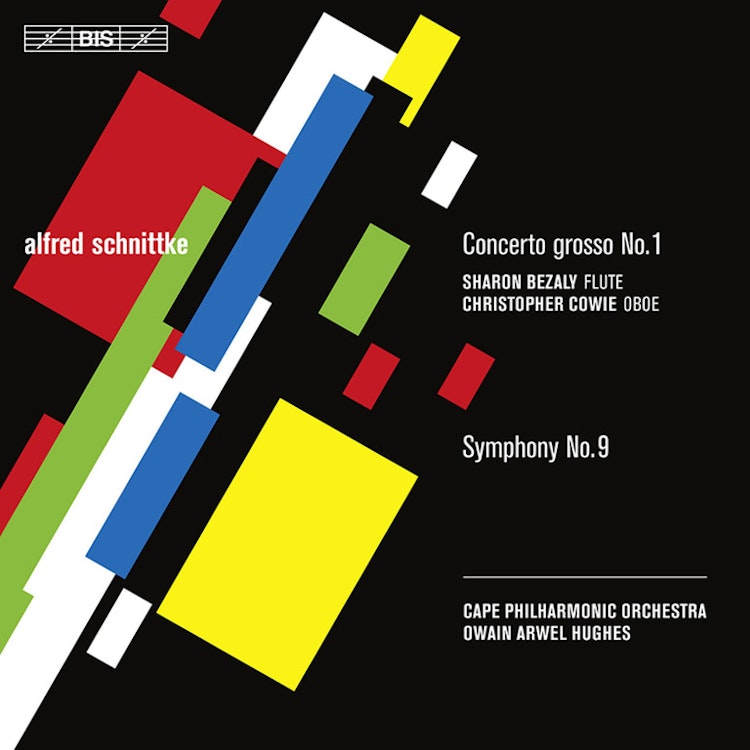
Schnittke, A.: Concerto Grosso No. 1 (Version for Flute and Oboe) / Symphony No. 9
7/1/2010, 9 Tracks, 1:01:25
Featuring
Owain Arwel Hughes
Sharon Bezaly
Christopher Cowie
Cape Town Philharmonic Orchestra
Alfred Schnittke
Did you know?
1/7
Composer's Artistic Vision
Schnittke aimed to bridge the gap between 'serious music' (Ernste Musik) and 'entertainment music' (Unterhaltungsmusik), even if it meant taking risks.
Composition History
Alfred Schnittke suffered a stroke in 1994 which left him unable to speak, but he continued composing with his left hand, completing his Symphony No. 9, a Viola Concerto, and Variations for String Quartet before his death.
Compositional Technique
Alfred Schnittke's Concerto grosso No. 1 is a 'polystylistic' composition, incorporating diverse elements like a Soviet popular song, a nostalgic atonal serenade, and a tango.
Composer Biography
Alfred Schnittke (1934-98) was restricted from traveling to Western countries and attending premieres of his works until he was 43, due to the Soviet Composers' Union.
Composition History
Schnittke's Symphony No. 9 was difficult to read because he wrote it with his left hand after a stroke, leading to multiple attempts at reconstruction by other composers.
Performer Biography
Sharon Bezaly, the flutist on this album, was described by The Times (UK) as 'God's gift to the flute' and has had seventeen concertos dedicated to her by renowned composers.
Composition History
The Concerto grosso No. 1 was originally for two violins, prepared piano, and strings, but Schnittke created a new version in 1988 for flute and oboe at the request of Russian oboist Viacheslav Lupachev.
You might also enjoy...
1941-1945: Wartime Music, Vol. 3
Myaskovsky: Symphonies Nos. 24 and 25
Lokshin: Symphony No. 4, "Sinfonia Stretta" / Three Scenes From Goethe's Faust