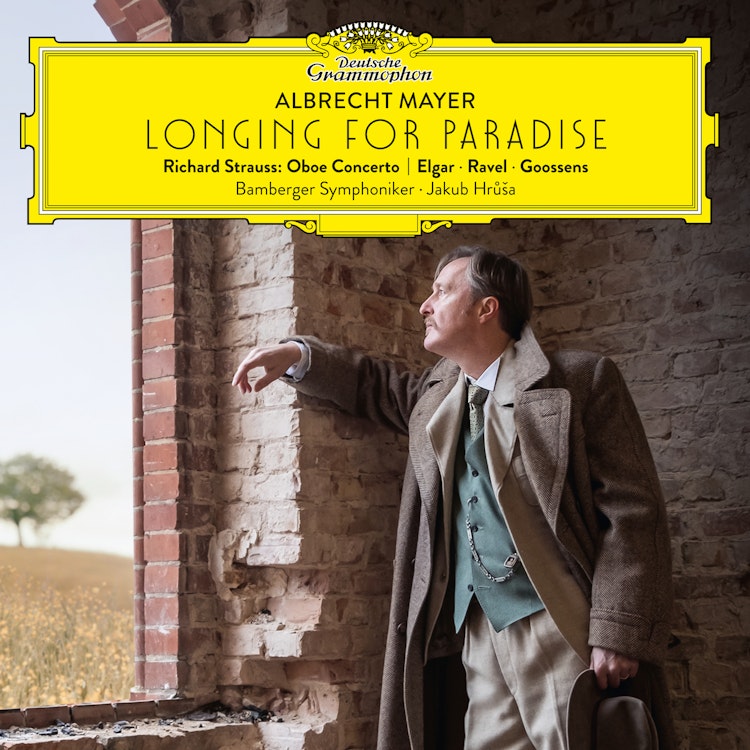
Oboist Albrecht Mayer presents four early 20th-century works haunted by the spectre of war. Elgar's Soliloquy (1930) is a fragment from an uncompleted work that remained unperformed until 1967. Richard Strauss's and Eugene Goosens's Oboe Concertos (1945 and 1927) both delight in the virtuosic abilities of their original soloist, Eugene's brother Léon. Ravel's Le Tombeau de Couperin (1919), his first work written after serving in the First World War, is a highly personal piece influenced by the French Baroque. The arrangement for solo oboe and orchestra is by Joachim Schmeißer.
Featuring
Jakub Hrůša
Albrecht Mayer
Bamberger Symphoniker
Edward Elgar
Richard Strauss
Maurice Ravel
Sir Eugene Goossens
Did you know?
1/7
Composer's Artistic Vision
The album's pieces share a common theme: composers reacting to war and destruction with a yearning for beauty, dreaming of paradise.
Composer Biography
Edward Elgar and Richard Strauss knew and admired each other personally, with Elgar hosting Strauss in London in 1922 and the Elgars visiting Strauss in Garmisch in 1909.
Composition History
Maurice Ravel's Le Tombeau de Couperin, completed in 1919, is a highly personal work dedicated to comrades who fell in World War I, embedded in baroque forms.
Composition History
Richard Strauss's Oboe Concerto was inspired by a conversation with American oboist John de Lancie in 1945, despite Strauss initially denying interest in writing such a piece.
Composition History
Edward Elgar's Soliloquy, originally intended as the second movement of a three-movement suite, remained a fragment until 1967 when it was completed by Gordon Jacob.
Historical Context
Edward Elgar, a sensitive spirit, had dark premonitions of approaching war as early as 1933, which are reflected in his Soliloquy.
Composition History
Eugène Goossens, from a musical dynasty, composed his Oboe Concerto in 1927 at the request of his brother, oboist Léon Goossens, for an American tour.
You might also enjoy...
Oboe Italiano
Romantic Oboe Concertos
Marcello, A.: Cetra Di Eterio Stinfalico (La) / Violin Concerto in B-Flat Major