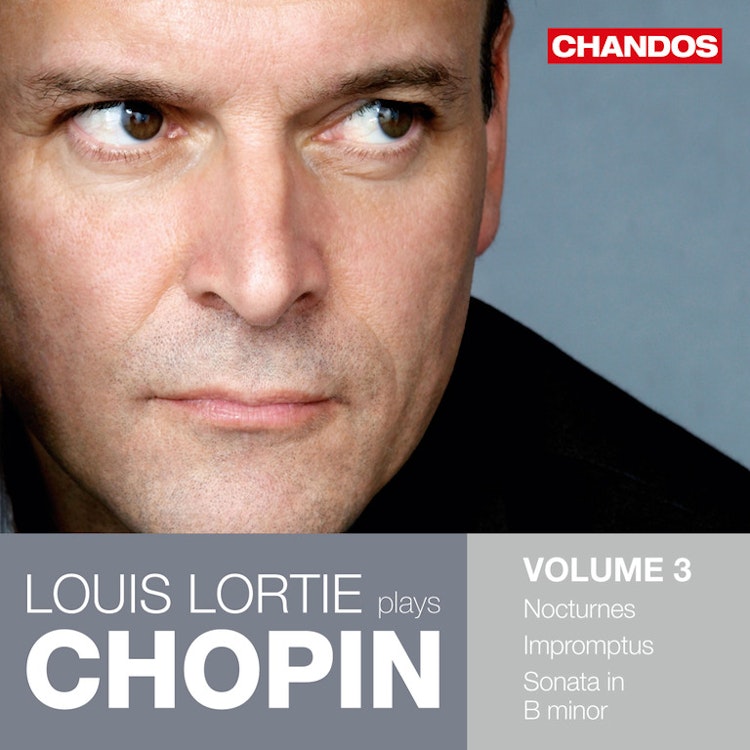
Louis Lortie Plays Chopin, Vol. 3: Nocturnes, Impromptus & Sonata in B Minor, Op. 58
4/1/2014, 13 Tracks, 1:16:42
Featuring
Louis Lortie
Frédéric Chopin
Did you know?
1/7
Compositional Technique
Chopin sometimes ended his Nocturnes with codas that dissipate rather than resolutely stop, creating a melting-away effect.
Interpretation
Pianist Louis Lortie plays a nocturne before a major Chopin composition to compensate for the lost art of improvising an introduction in the same key, making the nocturnes feel more improvisatory.
Composition History
Chopin did not publish his famous C sharp minor Impromptu (Fantaisie-Impromptu) because he considered it the private property of Baroness d'Est, to whom he gifted the manuscript in 1835.
Composer's Artistic Vision
Chopin's Nocturnes, derived from John Field's piano genre, retained their association with evening entertainment but also achieved a profound new depth, with listeners sensing a 'soul' within them.
Composition History
Chopin's Sonata in B minor, Op. 58, composed in 1845, helped revive the sonata genre, inspiring works by composers like Liszt, Thalberg, and Kalkbrenner.
Composition History
When Chopin first turned his attention to the impromptu around 1834, the genre was quite new, dating back only to 1817 with the Bohemian composer Jan Václav Voříšek.
Composer's Artistic Vision
Chopin's Impromptus, despite their name suggesting improvisation, were generally intended as pieces lacking pretension and aiming for casual entertainment rather than high artistic expression.
You might also enjoy...
Chopin: Piano Works
Chopin
Chopin
Louis Lortie Plays Chopin, Vol. 1
Chopin: Piano Works
Mordecai Shehori Plays Frédéric Chopin, Vol. 9: The Complete Nocturnes, Pt. 2
Chopin: Nocturnes, Mazurkas, Ballades and Other Piano Favorites