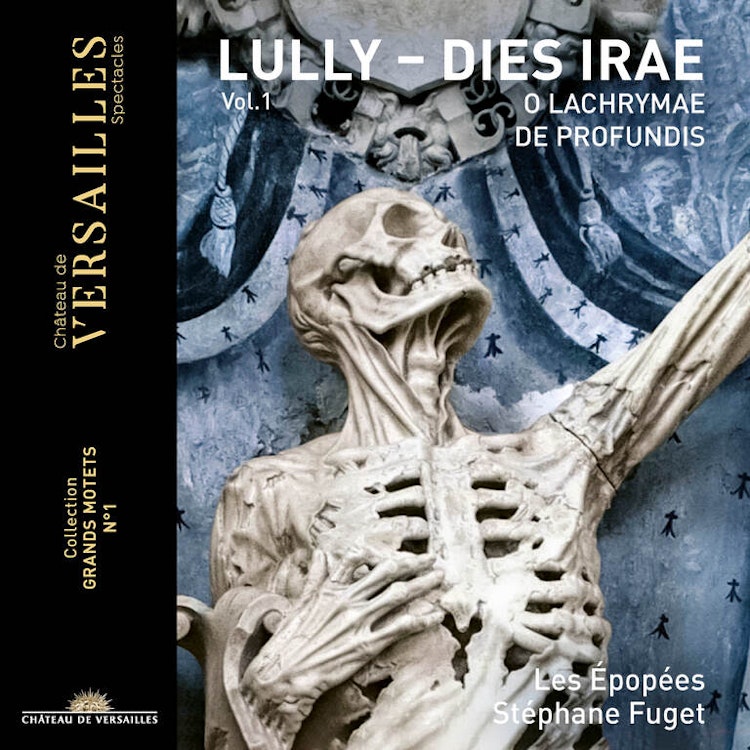
Lully: Dies Irae (Collection Grands motets, Vol. 1)
2/12/2021, 22 Tracks, 1:09:09
Featuring
Stéphane Fuget
Ambroisine Bré
Caroline Arnaud
Lucy Page
Marie Perbost
Clément Debieuvre
Cyril Auvity
Serge Goubioud
Marc Mauillon
Benoît Arnould
Luc Bertin-Hugault
Olivier Gourdy
Renaud Brès
Thierry Cartier
Claire Lefilliâtre
Jeanne Lefort
Marie Zaccarini
Marco Angioloni
Imanol Iraola
Les Epopées
Jean-Baptiste Lully
Did you know?
1/7
Composition History
Lully obtained a royal privilege from Louis XIV in 1672 to stage opera, leading to the creation of the Académie Royale de Musique, which is now the Opéra National de Paris.
Composer Biography
Lully was a tireless musician, serving as a violinist, singer, composer, dancer, and theatre director, and was a dance companion to the young Louis XIV in court ballets.
Interpretation
Stéphane Fuget, the conductor of Les Épopées, believes that Baroque scores are mere frameworks, requiring performers to add extensive ornamentation and declamation to bring the music to life.
Composer Biography
Jean-Baptiste Lully, born Giovanni Battista Lulli in Florence in 1632, arrived in Paris at age 14 and became the inventor of French opera.
Composer's Artistic Vision
Lully, in collaboration with author Philippe Quinault, developed the 'tragédie lyrique,' a French adaptation of Italian opera and court ballet, emphasizing dance and chorus.
Composer Biography
Lully's famous Te Deum, composed for his son's baptism, led to his death in 1687 after he injured his foot with a time-beating cane while conducting it.
Composer Biography
Lully, as Superintendent of Music to Louis XIV, held omnipotent power over the musical world for two decades, giving new breadth to the King's sacred music.
You might also enjoy...
Legrenzi: Harmonia d'affetti devoti, Libro 1, Op. 3
Musik der Benediktiner
Rameau : Les grands motets
Michael: Musicalische Seelenlust
Rameau: In convertendo Dominus: VII. Chœur. "Euntes ibant et flebant"