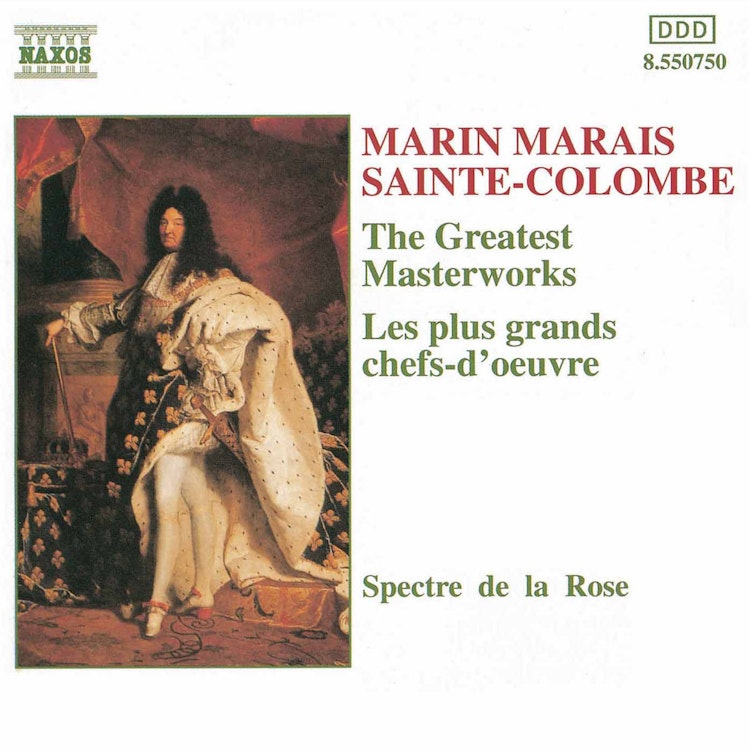
Marin Marais' five volumes of 'Pièces de Violes', published between 1686 and 1725, were written for 'amateur' players among the nobility, containing suites with pieces of varying difficulty.
Composer Biography
Marin Marais (1656-1728), a pupil of Sainte-Colombe, became 'Ordinaire de la Chambre du Roi' at age twenty-three, serving at court for six months each year and dedicating the rest of his time to composing, teaching, and performing.
Composer Biography
Monsieur de Sainte-Colombe (died c.1700), an elusive French viol player, added a seventh string to the traditional six-stringed viol and introduced metal winding for the gut bass strings to enhance its sound.
Instruments
The viol initially found favor in England due to its resemblance to the lute, with its six strings and frets, but offered greater expressive potential with a bow.
Historical Context
In 1636, when French theorist Marin Mersenne wrote about the viol, it was a relative newcomer to French musical life, but fifty years later it was the most highly revered instrument.
Performer Biography
Spectre de la Rose, formed in 1991 by British Early Music exponents, varies in size from three to seven members and made its first recording with this album for Naxos.
Compositional Technique
Sainte-Colombe's 'Concerts a deux violes esgales' (a volume of over sixty pieces for two bass viols) are written in a style inherited from the lute tradition, notably through extensive use of chordal passages.
You might also enjoy...
Birds on Fire - Jewish Music for Viols
Luzzaschi & Agostini: Le concert secret des Dames de Ferrare
Campo: Quintetto Vicento / Flaherty: Good Times / Kohn: San Gabriel Set / Heussenstamm: Largo